Continuous Linear Lighting: The Join Detail That Decides the Whole Run
Continuous linear lighting works when the luminaires, joins, corners, feed points, end caps and ceiling conditions are treated as one coordinated system. The run is usually decided by its join detail, not by the first line drawn on the plan.
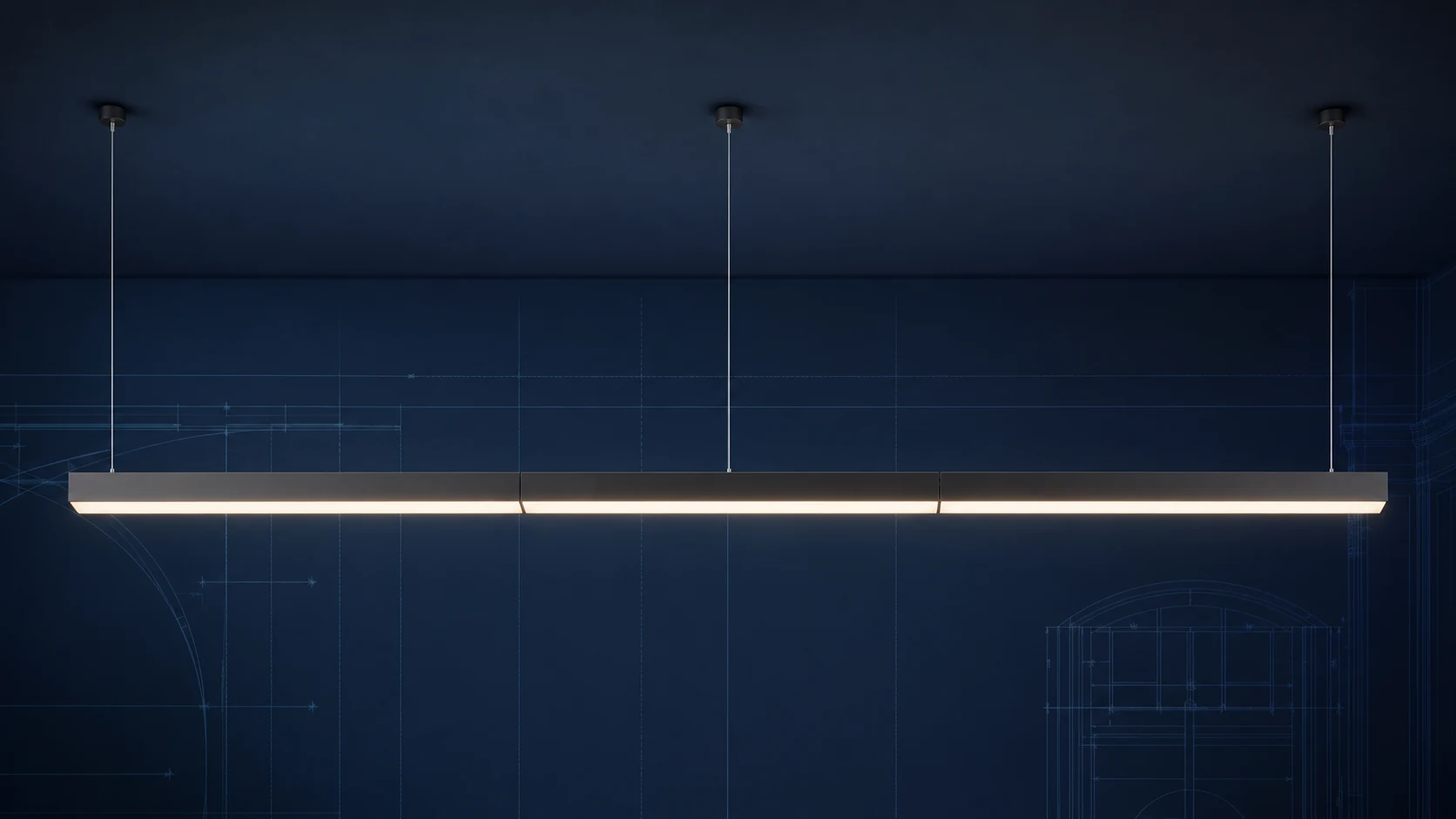
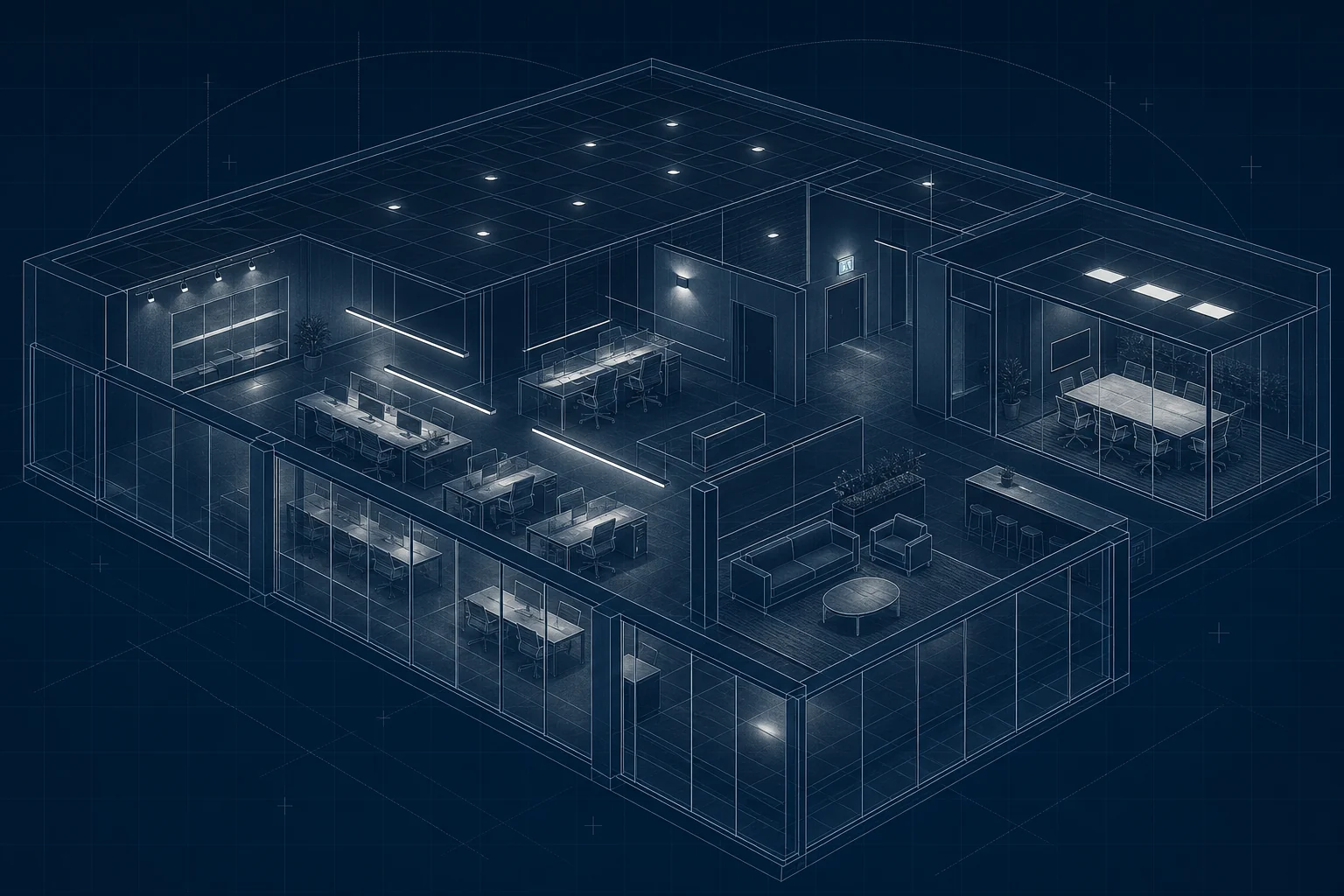
Continuous linear lighting often looks straightforward on plan. Then somebody overlays the ceiling grid, the access panels, the sprinkler heads and the feed position, and the “clean line” suddenly needs a small miracle. In practice, the run is usually decided by the join detail, not by the sketch.
Short answer: continuous linear lighting works best when the luminaires, joins, corners, feed points, end caps and ceiling conditions are treated as one coordinated system. If those details are left until late in the job, the result is rarely a convincing uninterrupted line. It becomes a sequence of compromises with an expensive haircut. Lumenloop’s linear lighting product hub brings the relevant product families together once the route and mounting method are clear.
That does not mean continuous runs are awkward by definition. It means the specification needs to answer a few practical questions early: is the run recessed, surface-mounted or suspended; where can it start and finish; how does it handle corners and interruptions; and what product family actually supports that arrangement? The current BS EN 12464-1 workplace lighting standard and the SLL Code for Lighting both reinforce the wider point: the lighting result should be assessed in the real room condition, not only as an abstract product line.
What “continuous linear lighting” really means on a project
Specifiers often use the term to mean any long linear fitting. On site, the distinction is more useful. A true continuous system is not just a row of separate luminaires placed close together. It is a family of modules and accessories intended to create a coordinated visual line, including the parts that nobody notices until they go wrong: the joint, the feed location, the corner, the end cap, the blank infill, the suspension set, the recessed trim detail or the access allowance for maintenance.
That is why the run geometry matters as much as the light output. A neat reflected ceiling plan can fall apart if the product cannot turn a corner cleanly, if the ceiling module forces an awkward offset, or if the electrician has nowhere sensible to bring the feed in. The fitting may still switch on perfectly well. It just will not look like the line everybody thought they were buying.
Where continuous linear LED lighting systems are usually specified
Most continuous linear LED lighting systems appear in offices, education spaces, retail settings and wider commercial interiors where a cleaner ceiling rhythm matters as much as the raw light level. In those spaces, the specifier is often comparing more than one linear light format: a recessed linear light for a flush ceiling line, a suspended luminaire for a more visible architectural run, or a modular LED linear lighting system that can carry the same visual language through longer areas.
That is also why installation and mounting options need to be discussed early. Surface, recessed and suspended mounting options do not simply change the appearance of the luminaire. They affect the installation route, ceiling access, connector positions, output choices, colour temperature coordination and the practical relationship between the linear lighting system and the room. Contractors, consultants and clients may all say they want continuous linear lighting, but the correct commercial LED linear lighting answer still comes back to the actual ceiling and the intended use of the space.
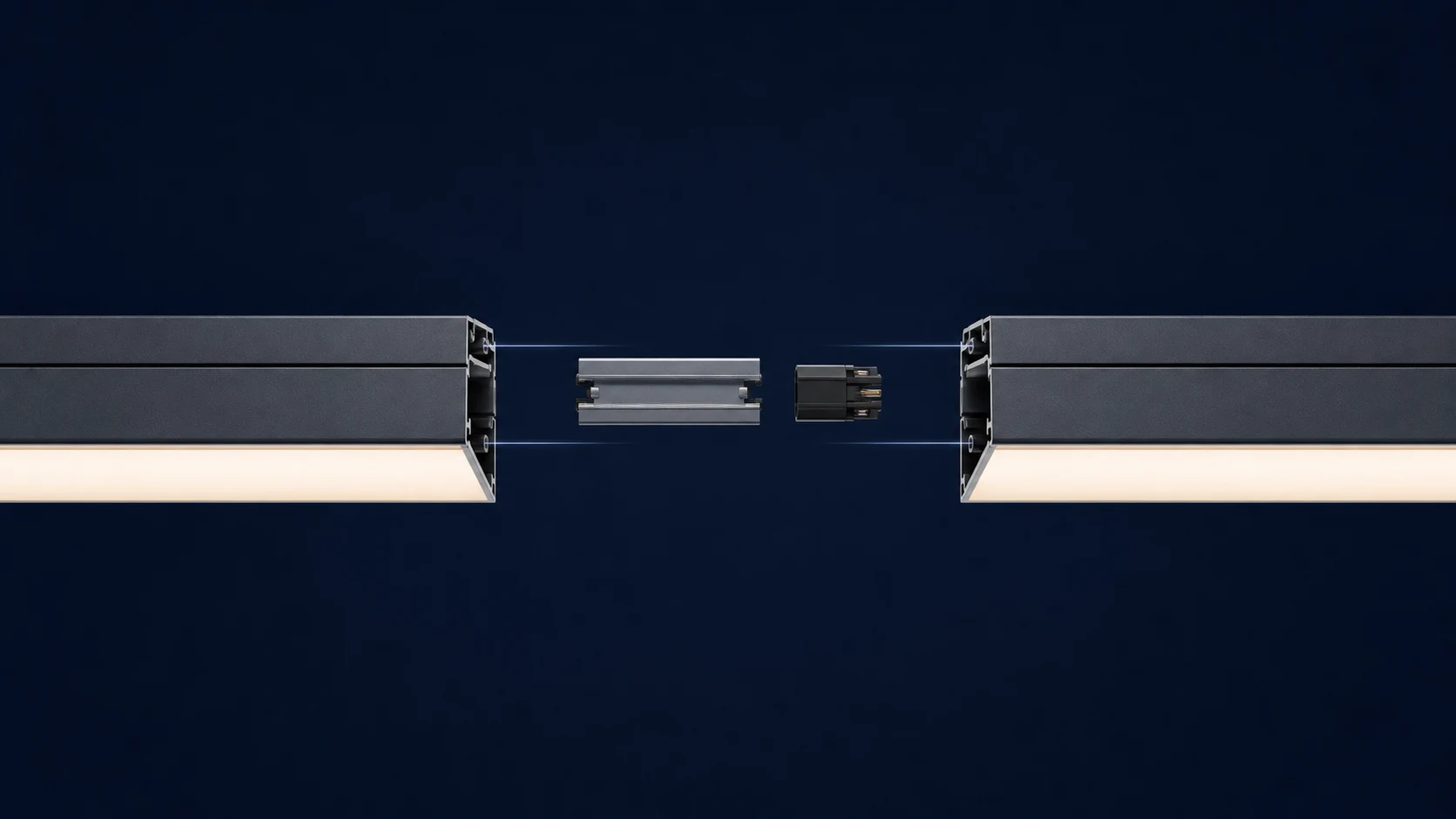
The join detail usually decides the whole run
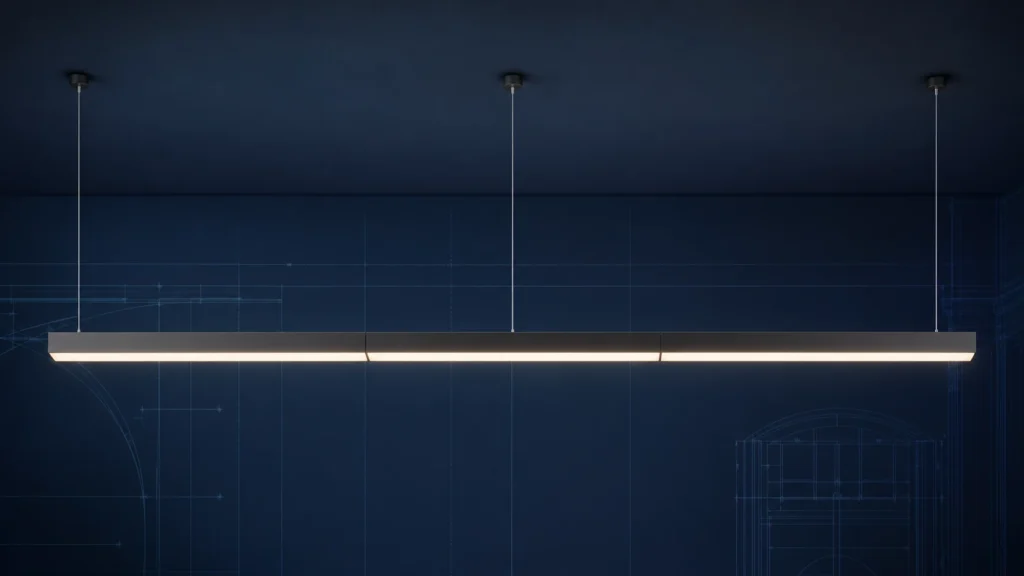
If there is one detail to settle early, it is the join. Not because it is glamorous, but because it affects almost everything else. The joint determines whether diffuser lines remain visually consistent, whether small alignment errors become obvious, whether through-wiring is straightforward, and whether future maintenance turns into a tidy module swap or a longer argument.
Corners deserve the same attention. A drawing may show a right-angle turn as if it were automatic. In reality, the corner needs a compatible product solution or a deliberate break in the composition. Lumenloop’s Lumenline continuous linear LED system, for example, is positioned as a companion system with dedicated corner sections, colour-matched infills, end caps and through-wiring support. That makes it useful where the visual continuity is part of the brief rather than an afterthought added to a standard batten-shaped product.
End caps matter too. People sometimes treat the end of the run as a minor accessory choice, but it is part of the visible composition. A strong run that dissolves into an untidy stop is a bit like a tailored suit with one trainer. Comfortable, perhaps, but not the look originally discussed.
Suspended and surface continuous runs are a different decision from recessed runs
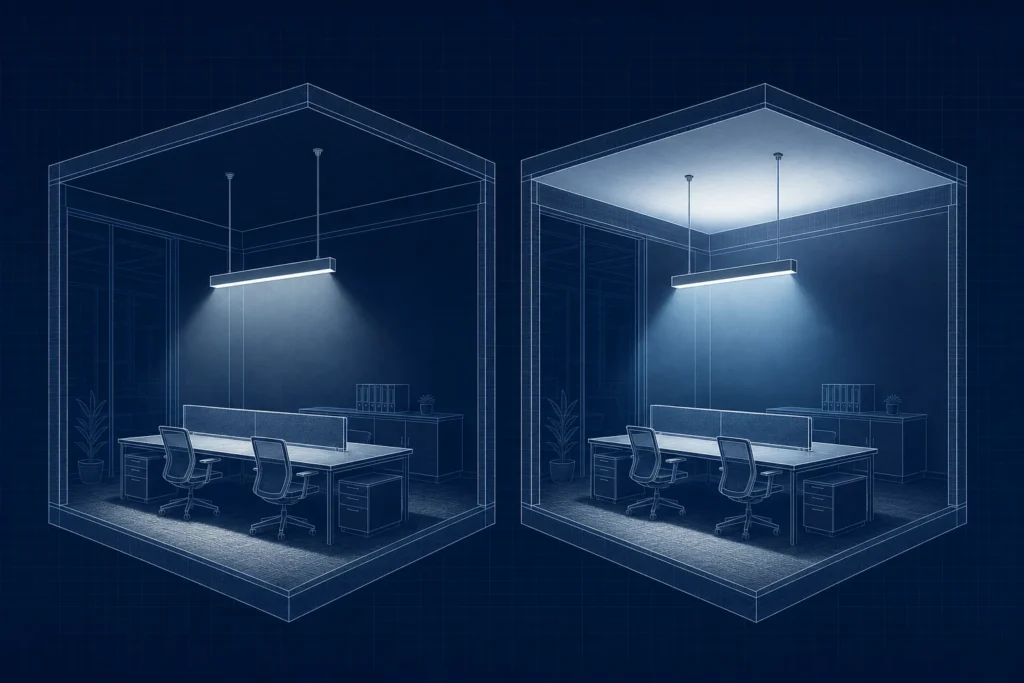
This is where many early sketches become too general. Suspended or surface continuous lighting and recessed continuous lighting may answer similar architectural briefs, but they do not ask the same site questions. Recessed runs must negotiate ceiling build-up, module setting-out, access panels, service clashes and trim accuracy. Suspended or surface runs still need coordination, but they are less dependent on the ceiling becoming a perfect host surface.
| Specification question | Suspended or surface continuous run | Recessed continuous run |
|---|---|---|
| Primary coordination point | Run geometry, feed position, suspension or fixing logic and visual alignment | Ceiling module, cut-out setting-out, access, service coordination and trim detail |
| Best starting use case | Where the line should remain visually explicit in the room | Where the line should sit flush within a coordinated ceiling plane |
| Common risk | Awkward feed entries or corners that break the rhythm | Ceiling clashes forcing broken runs, offsets or late product changes |
| Relevant product route | Line, Lumenline or, where an upward component is needed, Radiance | Flow or Path depending on the glare and ceiling brief |
| What still needs checking | Run lengths, joins, corners, suspension positions, controls and emergency provision | All of the recessed coordination detail plus the run geometry, controls and emergency provision |
For a visible modular line that can be surface-mounted or suspended, the Line modular continuous linear LED system is relevant because it is built around joined modules and through-wiring rather than pretending a single fitting can answer every arrangement. For recessed projects, Flow and Path are the more natural product routes because the discussion becomes low-glare performance, ceiling compatibility and run discipline within the ceiling plane.
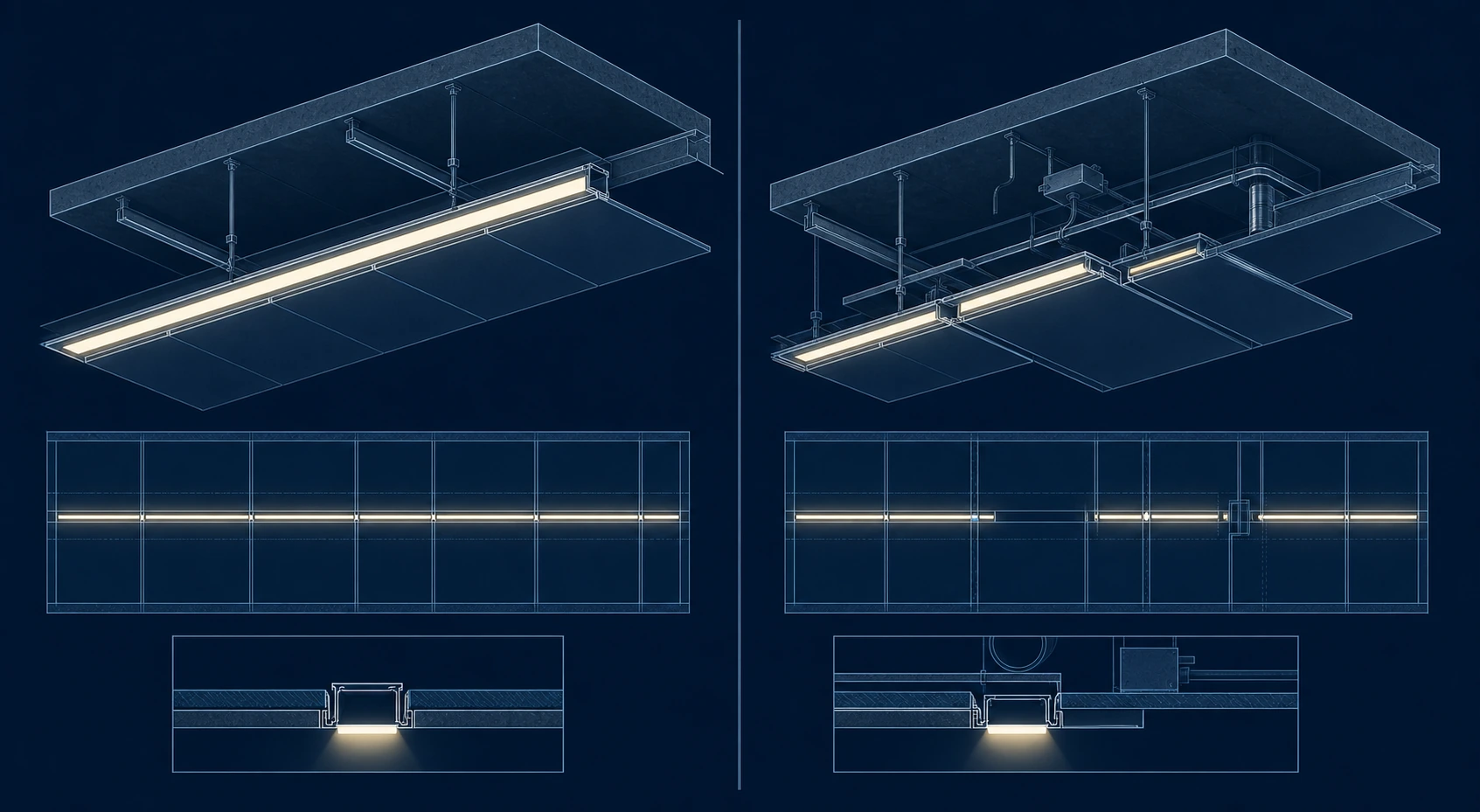
Five checks before the order goes anywhere near a ceiling
1. Check the ceiling and the route before choosing the product
Ask what the run has to pass through or sit within. Ceiling grids, plasterboard joints, rafts, access panels, bulkheads, detectors and sprinklers are not later-stage decoration. They are the environment that decides whether the run remains continuous in practice. This is especially important for recessed schemes, where the ceiling module can quietly become the boss of the whole composition.
2. Decide where the feed enters and where the run can finish
A beautiful central section tells you very little unless the beginning and end are solved as well. Feed position affects the neatness of the installation and can alter how the modules are sequenced. The end treatment affects the finished visual line. Neither should be left as a vague installer problem when the design intent calls for a disciplined result.
3. Treat corners, offsets and interruptions as deliberate design moments
Some projects need a true corner section. Others are better served by ending one run cleanly and starting another on purpose. What usually disappoints is the halfway option: a layout drawn as continuous, then bodged around an obstacle with small offsets that look accidental. If the route cannot remain clean, it is often better to admit that earlier and specify the line accordingly.
4. Keep run geometry separate from controls and emergency decisions
This matters because the specification conversation can become muddled. Continuous linear lighting describes the physical arrangement of the luminaire system. DALI, DSI, SwitchDIM, Casambi, sensors and emergency options describe control and emergency functions. They may all be part of the same schedule, but they are not the same decision. A clean recessed run does not become more continuous because somebody added a controls line to the spreadsheet.
5. Ask for product-backed run logic, not only a family resemblance
If the project brief calls for a real continuous system, check that the selected family genuinely supports the required arrangement. Lumenline is positioned with dedicated companion-run components including corner sections, infills and end caps. Flow includes joining and through-wire accessories for recessed installations. Those are the kinds of clues that the run has been thought through at product level rather than described hopefully in a mood board.
Compare Lumenloop linear lighting products
Once the route logic is clear, use the Lumenloop linear lighting product hub to compare the available formats, then check the specific product page for the required mounting and run arrangement:
- Line: modular continuous system for projects needing a visible surface-mounted or suspended linear run with joined modules and through-wiring.
- Lumenline: companion continuous system with dedicated lengths, corner sections, infills, end caps and suspension options where the run detail itself is central to the scheme.
- Flow: recessed low-glare linear option where the project needs a disciplined ceiling-integrated run, with joining and through-wire accessories available.
- Path: recessed low-glare linear route where the brief is more focused on clean office-grade integration and glare control.
- Radiance: relevant when the project needs a continuous direct/indirect linear system rather than a purely downward visual line.
The useful sequence is therefore: decide the run, confirm the ceiling condition, then compare the product family. Doing that in reverse is how many “continuous” schemes end up obviously discontinuous by the second coordination meeting.
Questions specifiers usually ask
Is continuous linear lighting always better than separate linear fittings?
No. It is better when the visual continuity is useful to the architecture and the system can be coordinated properly. If the ceiling conditions are fragmented or the route is repeatedly interrupted, separate fittings may produce a cleaner outcome than a “continuous” line that obviously is not.
What usually goes wrong with recessed continuous runs?
The main problem is late ceiling coordination. Grid lines, access panels, services and fixing conditions can force offsets or breaks after the linear concept has already been sold internally as a simple idea.
Can one product family cover straight runs, corners and blank sections?
Sometimes, yes, but it should be confirmed from the actual product information rather than assumed from appearance. Systems such as Lumenline explicitly reference corner sections, infills, end caps and through-wiring support, which is exactly the type of evidence worth checking before the quotation stage.
Should controls and emergency provision be part of the same conversation?
They should be part of the same schedule, but not confused with the run geometry. First confirm whether the line itself works architecturally and physically. Then confirm the control and emergency requirements for the selected family and configuration.
Continuous means coordinated
The real specification question is not whether a project likes linear lighting. It is whether the proposed route, ceiling and product family can produce a convincing continuous result without awkward late compromises. If you are weighing recessed versus suspended options or need help matching the run logic to the right product family, compare the linear lighting range and contact Lumenloop with the room use, mounting method, run lengths and control requirements.