
UGR belongs to an installation
A UGR<19 product option supports a low-glare scheme, but the calculated result also depends on room geometry, spacing, surface reflectance and viewing position.
Compare UGR<19 and LG7-focused panel families for offices, education and healthcare. Published glare evidence is one part of the product record; use the exact model data alongside the project requirements.
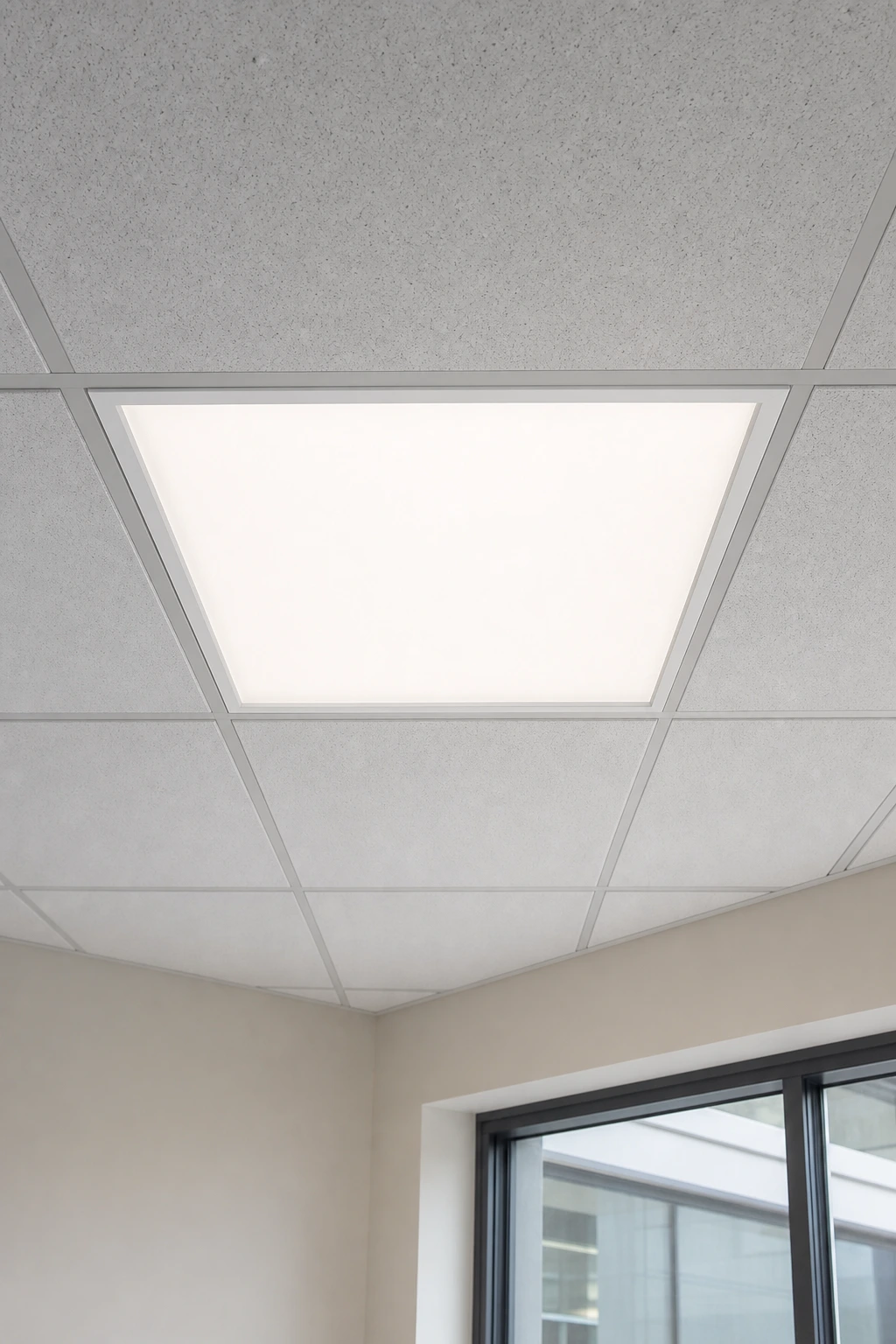
Compare application, published glare evidence and listed control or emergency options across the panel families. Check the selected optic, ceiling module, output and colour temperature against the exact model datasheet.
Choose an application, glare requirement and control option. The shortlist updates as you select; open a family below to compare its dimensions, light output and available variants.
Compare optical performance and ceiling construction, then use the exact product data for the intended installation.
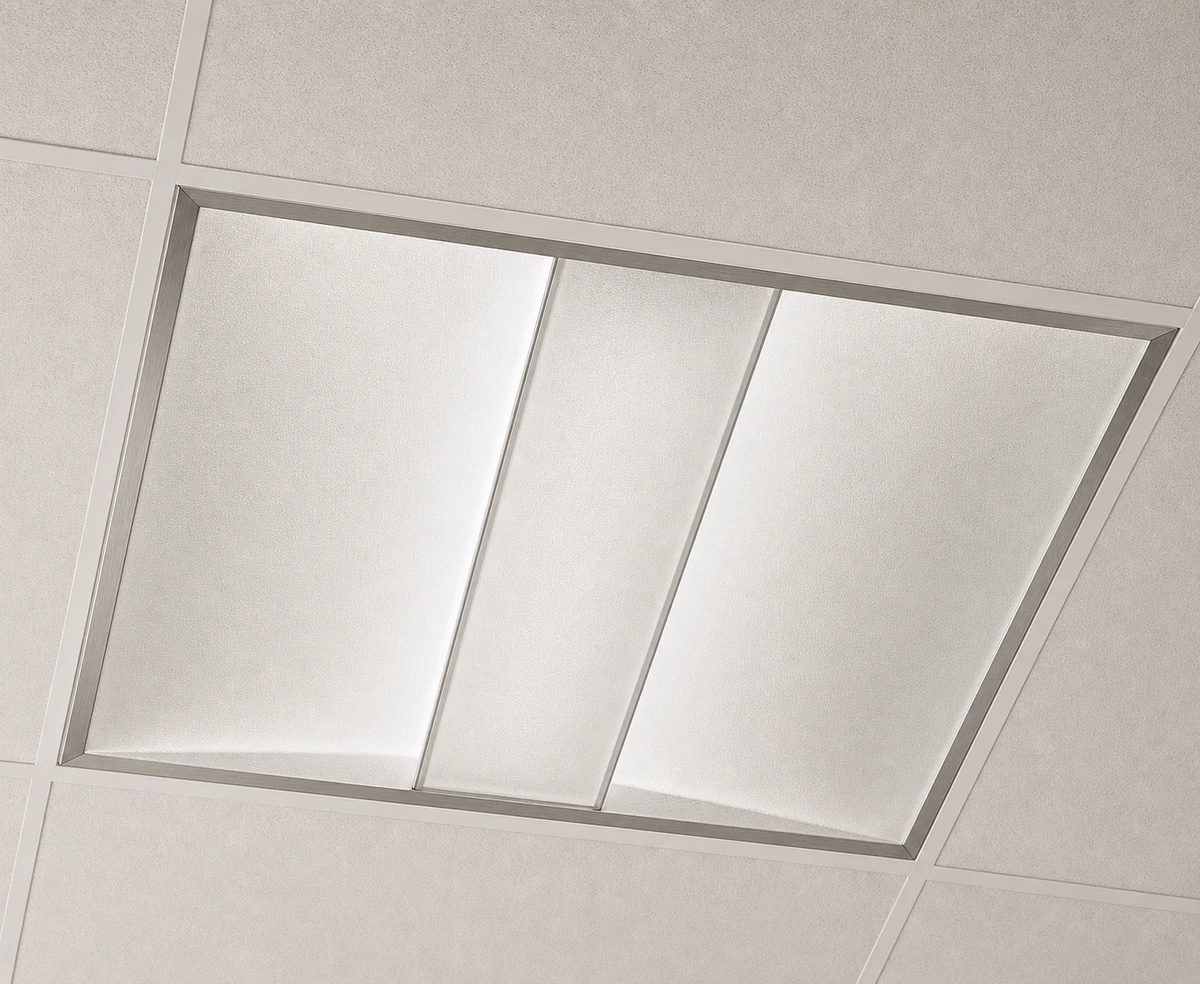
A UGR<19 product option supports a low-glare scheme, but the calculated result also depends on room geometry, spacing, surface reflectance and viewing position.
Edge-lit, back-lit and direct/indirect constructions create different visual and technical propositions. The right comparison goes beyond the 600 × 600 footprint.
Ceiling module, driver position, control protocol and emergency arrangement should be coordinated before the final product code is selected.
Edge-Lite is edge-lit, Lucid is recessed, Luminate is direct/indirect and Aurora is back-lit. Compare their published light output and listed options, then open the exact product for model details and technical downloads.
| Family | Construction and format | Visual-comfort evidence | Published output span | Useful option evidence |
|---|---|---|---|---|
| Edge-Lite | Edge-lit · 595 × 595 mm | UGR<19 | 3,400–4,700 lm | DALI · Casambi · Emergency |
| Lucid | Recessed · 600 × 600 mm | UGR<19 · LG7 evidence | 2,700–3,900 lm | DALI · Casambi · Emergency |
| Luminate | Direct/indirect · 600 × 600 mm | LG7-focused low-glare versions | 2,975–5,125 lm | DALI · Casambi · Emergency |
| Aurora | Back-lit · 600 × 600 mm | UGR<19 · TP(a) | See model datasheet | Up to 134.7 lm/W · DALI · Sensor |

595 × 595 mm panel family with low-glare, control and emergency variants.
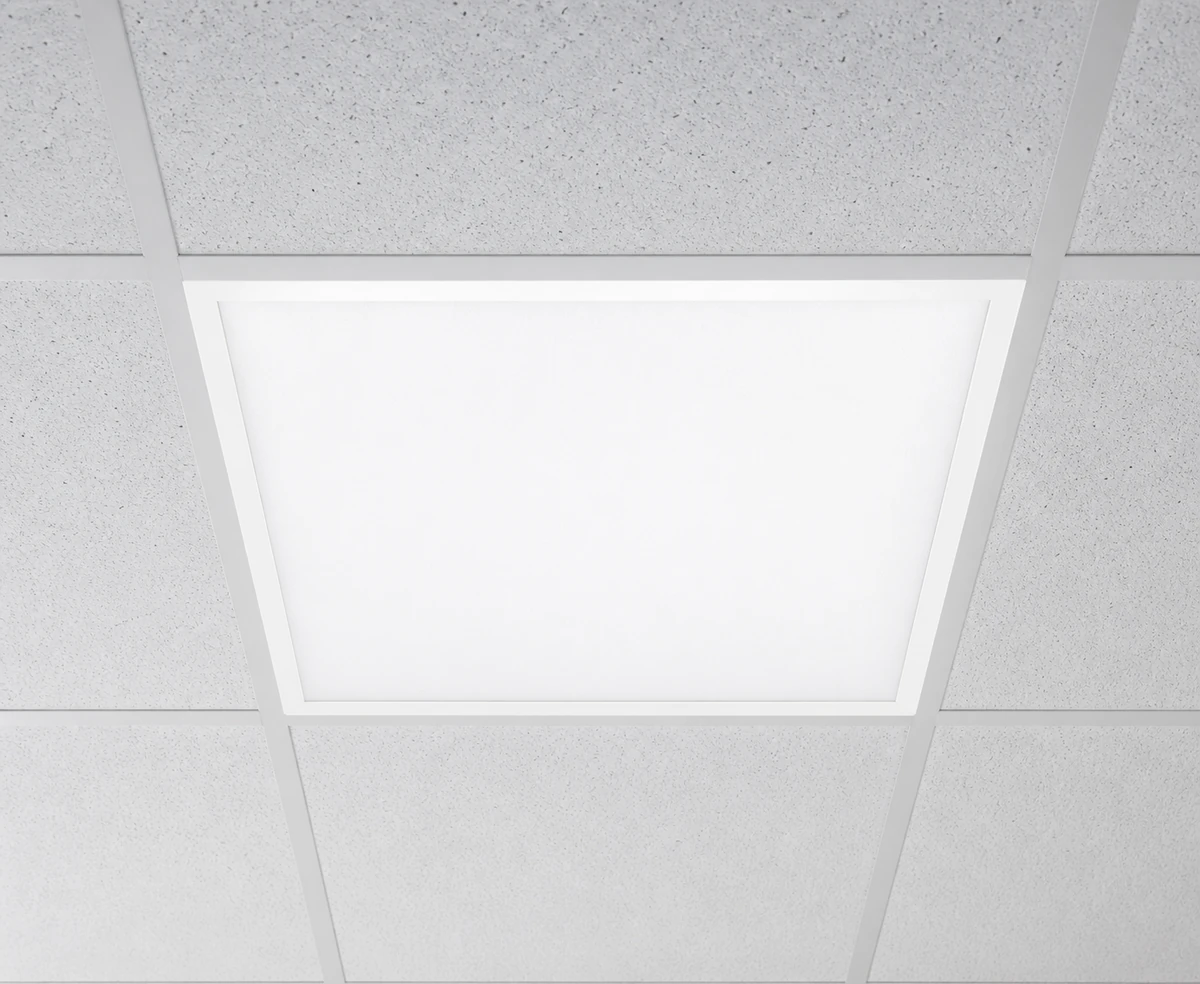
600 × 600 mm recessed panel with UGR<19 and LG7 evidence.
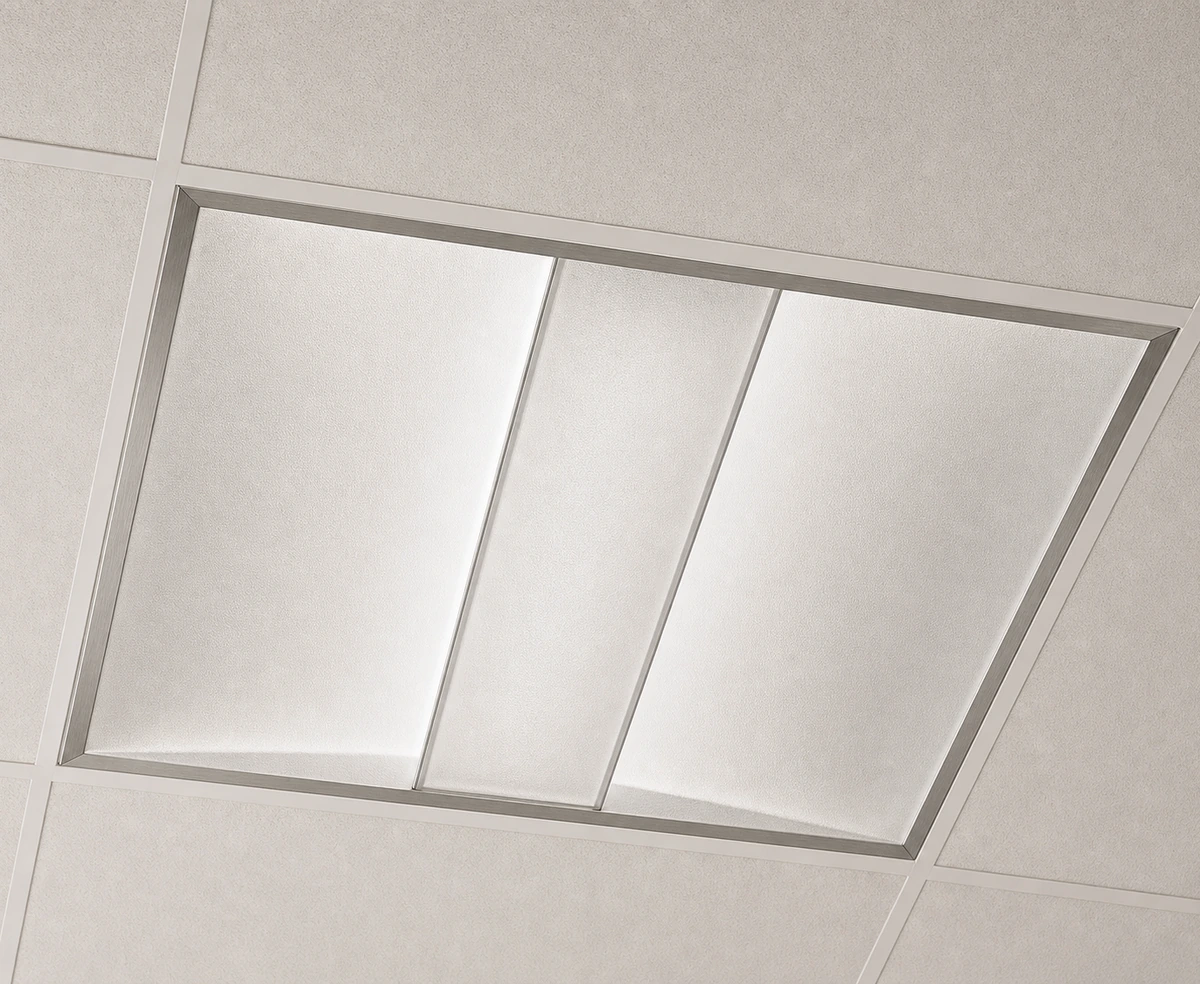
600 × 600 mm panel family with microprism optics and LG7-focused low-glare versions.

600 × 600 mm back-lit panel with a UGR<19 option and TP(a) diffuser evidence.
Compare the light on the task, the appearance of the fitting and the installation requirements. These checks help distinguish LED panel lights that share the same ceiling module.
Unified Glare Rating describes discomfort glare in an installation. A published UGR <19 option is useful when comparing luminaires for office lighting, but it is not a guarantee of the same result in every room. Room proportions, surface reflectance, luminaire spacing and viewing direction all affect the calculated rating.
For commercial spaces with open-plan offices and screen-based work, check the selected optic and its photometric data alongside the project specification. Lucid combines UGR <19 and LG7 evidence; Luminate offers LG7-focused versions with microprism optics. LG7 is lighting guidance, so a product description alone does not establish compliance for a complete installation.
Edge-lit panels position the LEDs around the perimeter and distribute light across the luminous face. Edge-Lite provides this construction in a 595 × 595 mm fitting. A backlit LED panel places the light source behind the diffuser; Aurora combines this construction with a UGR <19 option and a TP(a) diffuser.
Luminate uses a direct/indirect arrangement with microprism optics. Even illumination depends on the optical distribution and installation, as well as the appearance of the luminous face. The visible illuminated surfaces differ from a flat panel, which matters when comparing the ceiling appearance as well as the light output. Recessed describes the mounting arrangement, rather than a separate optical technology: Lucid is a recessed panel family with its own published glare and output data.
A nominal 600 × 600 mm suspended ceiling module does not mean every panel has identical outer dimensions. Edge-Lite is listed at 595 × 595 mm; Lucid, Luminate and Aurora are shown in the 600 × 600 format. Use the dimensioned drawing for the exact fitting and confirm its compatibility with the ceiling grid.
Check the available recess depth, support requirements and access to the driver before ordering. For a surface mounted or suspended installation, confirm that the selected family has the appropriate mounting accessory; a recessed LED panel should not be assumed to include a surface frame or suspension kit. Emergency gear and controls may also affect the space and access required above the ceiling.
Edge-Lite, Lucid and Luminate list 3000K and 4000K options. Colour temperature, or CCT, describes the appearance of the light: 3000K is warmer, while 4000K is commonly described as cool white. Choose the required appearance for the interior and check the selected model code, rather than assuming every panel has adjustable CCT.
Colour temperature is separate from light output and glare control. A 4000K panel is not inherently lower glare than a 3000K version. Compare the optic, output and photometric data for the chosen combination, and keep the specified colour temperature consistent when replacing fittings within the same area.
Energy-efficient lighting starts with comparing useful light output and system power. Compare lumens as well as watts. The published family spans are 3,400–4,700 lm for Edge-Lite, 2,700–3,900 lm for Lucid and 2,975–5,125 lm for Luminate. These ranges cover different configurations; use the exact model data to establish the required output and electrical load.
Aurora lists efficacy up to 134.7 lm/W. Efficacy expresses the light output per watt, rather than a guaranteed reduction in energy consumption. LED technology can reduce the load compared with traditional lighting, but energy savings depend on what is being replaced and how it operates. When replacing fluorescent fittings, compare the complete existing and proposed system loads, operating hours and controls. Annual electricity use in kWh is total input watts divided by 1,000, multiplied by operating hours; multiply by the electricity tariff to compare running costs.
DALI options are listed across the four families. Edge-Lite, Lucid and Luminate also list Casambi and emergency variants; Aurora lists sensor options. Confirm the required driver and control arrangement against the exact product code. DALI, Casambi and standard switching are different specifications, not interchangeable descriptions of dimmable LED panels.
For emergency lighting, check the emergency version, rated emergency output and testing arrangement separately from the normal lighting output. When comparing lifespan and maintenance costs, use the documented LED life, driver information and warranty for the selected model. Browse the full LED panel lighting range for other commercial lighting applications.
TP(a) describes a thermoplastic diffuser classification; it does not describe resistance to dust or water. An IP rating addresses ingress protection. Requirements such as IP44 or IP65 should be checked against the exact luminaire and application, including whether a rating applies only to the exposed face. Aurora lists a TP(a) diffuser, but that should not be read as an ingress-protection claim for all four panel families.
A recessed panel presents a larger luminous surface and is commonly considered for general lighting in ceiling grids. Downlights use smaller apertures and offer different beam distributions. For commercial lighting projects, compare the required distribution, ceiling construction and glare data before choosing the fitting type; the two formats should not be treated as equivalent simply because their lumen outputs match.
Check more than the ceiling size. Office lighting specifications may require glare control, a particular light output, colour temperature and control protocol. Compare the exact low-glare optic and product data with those requirements; a standard diffused panel and a UGR <19 variant may have different optical performance.
It can be a replacement option where the dimensions, mounting, electrical supply and required illumination are suitable. Compare the complete luminaire specifications, including emergency provision and control compatibility. Matching the old fitting's footprint or wattage alone does not establish equivalent performance.
Higher output provides more light from the fitting, but the appropriate choice depends on the required illumination and installation. Compare the optical distribution and glare data alongside lumens. The highest-output version is not automatically the appropriate choice for every office or classroom.
Provide the panel family, quantity and required output, colour temperature, optic and mounting option. Include DALI, Casambi or emergency requirements where applicable. The product pages contain the technical information needed to identify the configuration for quotation.
Request a quotation for the selected panel family and quantity. Include the required colour temperature, output, mounting, control and emergency options so the quotation reflects the product you need.