DSI is a digital dimming protocol for commercial lighting control. It can still be useful where simple grouped dimming is enough, but it should not be treated as a direct substitute for DALI, Casambi, SwitchDIM or emergency monitoring.
DSI stands for Digital Serial Interface. In lighting, it is used to send a digital light-level command to compatible control gear, usually so a wired group of luminaires dims together.
The commercial question is not only what DSI means. It is whether DSI is the right control method for the wiring, driver choice, commissioning route and future maintenance of the project.
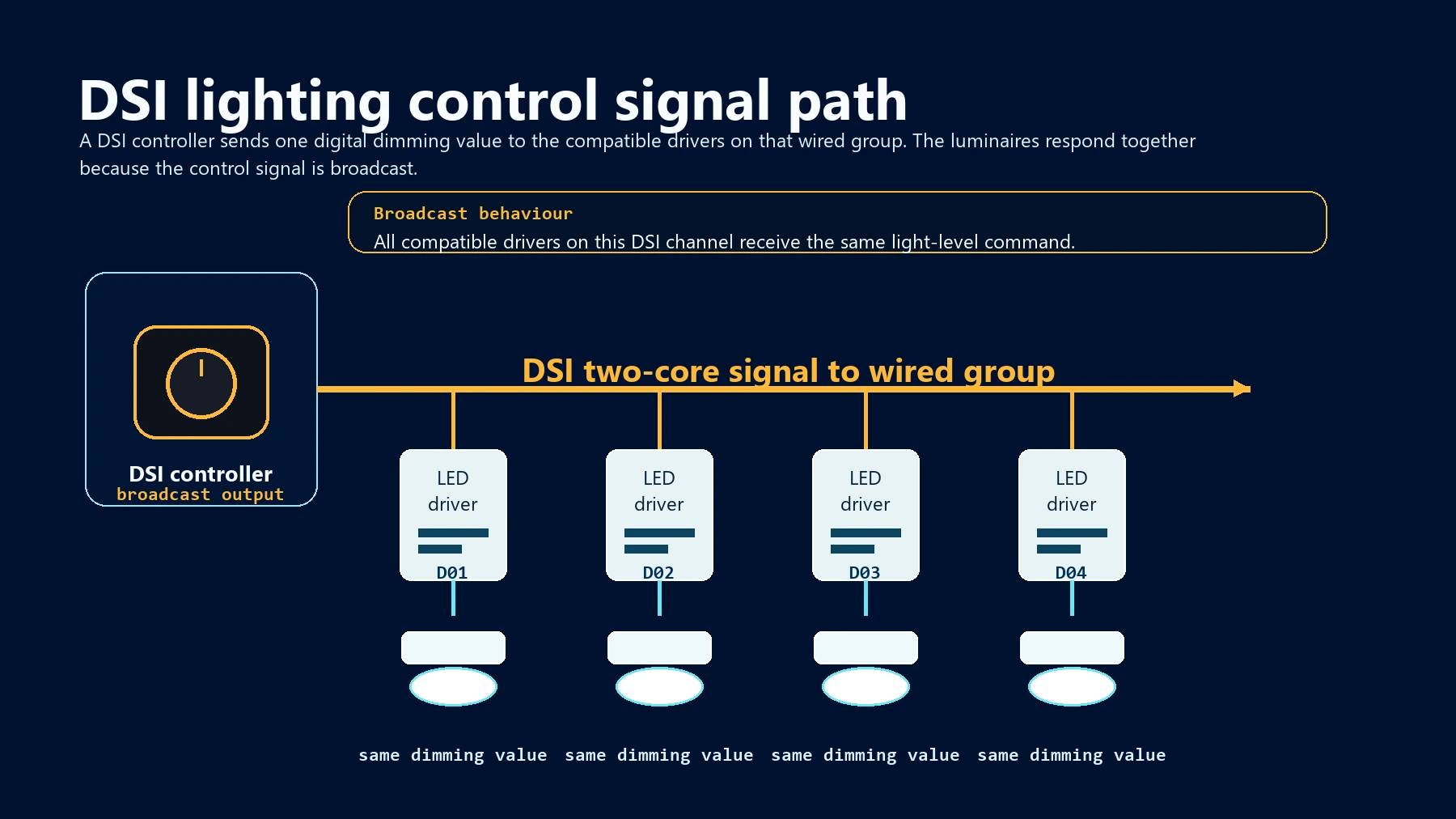
Short answer: what DSI means in lighting control
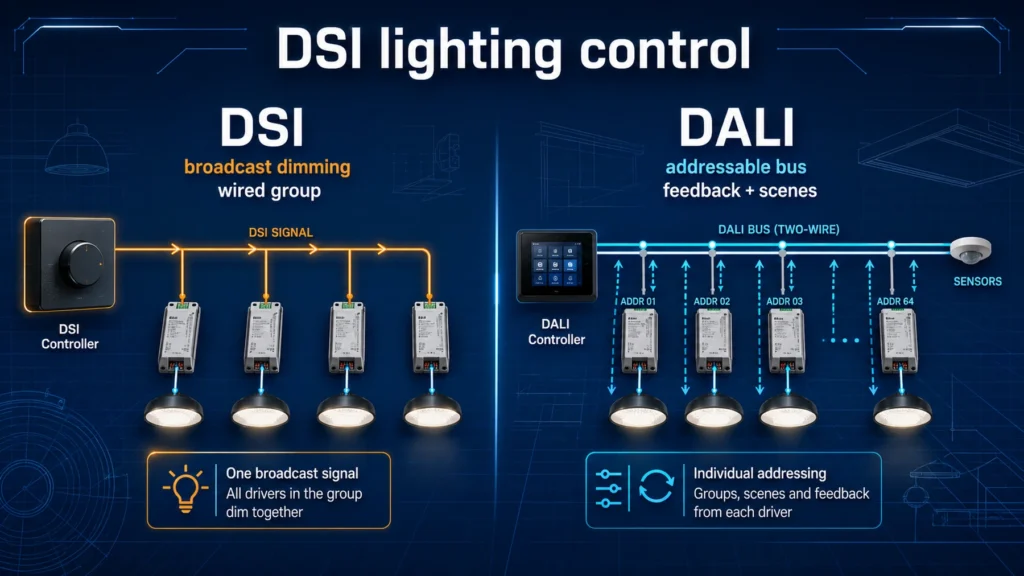
DSI is an early digital lighting control protocol used for dimming compatible drivers. It sends a broadcast dimming command rather than individually addressing each luminaire, so the connected drivers normally respond as a wired group.
That makes DSI simple to understand, but less flexible than DALI on projects that need addressable devices, scene changes, feedback, emergency reporting or later re-grouping.
How DSI dimming works
DSI is a digital control method rather than an analogue voltage dimming system. A controller sends a digital signal to compatible control gear, and the connected driver or dimmable ballast interprets that signal as a light level.
In older fluorescent installations this language often appears as DSI ballasts or digital dimmable ballasts. In LED projects, the same decision normally sits around the LED driver, control input and whether the fitting has the correct control gear option.
DSI is commonly described as using an 8-bit command for the dimming value. For a specifier, the important point is not the bit count by itself. It is that the command is broadcast to the connected channel, so the control of lighting is tied closely to the way the circuit or control pair has been wired.
How DSI differs from DALI
DSI and DALI are often mentioned together because DSI came before DALI and both sit in the digital lighting control family. The difference that matters on a project is addressing.
DSI is normally a broadcast control method. The control channel sends a dimming value and the drivers on that channel follow it. DALI is addressable, so individual drivers can be commissioned, grouped, queried and adjusted through the control system.
| Control method | How it behaves | What it means for the project |
|---|---|---|
| DSI | Digital broadcast dimming to compatible drivers | Simple group dimming where wiring and driver support are clear |
| DALI | Addressable digital control with two-way communication | Better for commissioned zones, feedback, scenes, BMS context and changes later |
| SwitchDIM | Push-button dimming on compatible drivers | Useful for simple local dimming without a full control network |
| Phase dimming | Mains dimming through compatible dimmers and drivers | Driver compatibility and load behaviour must be checked carefully |
| Casambi | Bluetooth mesh wireless control | Useful where app commissioning, wireless control, scenes or retrofit flexibility matter |
Tridonic’s driver function documentation separates DSI from DALI by the absence of individual driver addressing. That distinction matters because a DSI lighting control system is usually planned around wired groups, while DALI can be commissioned around addressed devices.
By contrast, the DALI Alliance key features describe DALI in terms of individual, group and broadcast addressing, software reconfiguration and querying over a two-wire bus. Those differences affect the luminaire schedule before anything is installed.
The DALI protocol can address devices individually, with each DALI subnet supporting up to 64 control gear addresses and 64 control device addresses. That does not automatically make DALI the right answer for every room, but it explains why DALI is often selected where the lighting control system needs more than a simple dimming channel.
Advantages and disadvantages of DSI
The main advantage of DSI is simplicity. Where the controller, driver and wiring are already compatible, DSI control can provide digital dimming without a full addressable commissioning process.
The disadvantage is the same thing seen from the other side. Because DSI does not address each device individually, the wiring usually defines the group. That can be fine for a stable room layout, but limiting for commercial lighting systems where zones, occupancy patterns, daylight response or tenant changes are likely to move over time.
DSI also sits in a narrower compatibility space than DALI. Tridonic is strongly associated with the original DSI protocol, and some manufacturers or product families support it through specific driver options. That is why compatibility needs checking rather than assuming any digital dimmer, ballast, module or LED driver will communicate in the same mode.
Where DSI can still make sense
DSI can still be a sensible choice where the project needs straightforward digital dimming and the control groups are already clear. It is most likely to appear on existing installations, simple grouped spaces or commercial lighting upgrade schedules where compatible drivers are already part of the specification.
For example, a small back-of-house area, simple office zone or retained control system may not need addressable DALI commissioning. If the wiring, controller and driver are already set up for DSI, changing the control method may add cost without improving the result.
DSI can also appear where daylight-linked dimming, presence detection or a local occupancy sensor is paired with DSI-compatible control gear. The sensor is the switching or control input; DSI is the way the control unit communicates the dimming level to the connected load.
The caution is that DSI’s simplicity depends on the project staying simple. Once separate scenes, flexible zones, central monitoring or emergency status reporting become part of the brief, the control method needs reviewing.
Where DSI becomes the wrong default
DSI is usually the weaker choice where the project needs individual luminaire addressing, software grouping, status feedback, detailed commissioning records or a future layout change. In those cases, the hardwired group can become the limitation.
A larger office lighting floor is a typical example. Meeting rooms, circulation, open plan desks and cellular offices may need different behaviour over time. If the control groups are fixed by wiring alone, later changes can become more awkward than they needed to be.
Emergency lighting is another common trap. DSI is a dimming protocol, not an emergency testing strategy. If the project needs self-test, DALI emergency reporting or a maintained emergency arrangement, those decisions must be handled through the emergency control gear and product selection, not assumed from the DSI label.
Lumenloop’s view: control choice belongs with the luminaire schedule
DSI should not be specified as a vague request for digital dimming. It should be tied to the driver, wiring method, control channel and product range.
Selected Lumenloop product data includes DALI, SwitchDIM and DSI-style control-gear options, but that does not mean every range, driver or emergency variant should be treated the same way. The useful check is range by range.
For a contractor or consultant, the practical risk is simple: a control method chosen too late can force substitutions, delay pricing or leave the emergency strategy sitting outside the main product schedule.
The better sequence is to decide the luminaire type, mounting condition, output, optics, driver/control method and emergency requirement together. That keeps the quotation closer to the real installation.
What to check before asking for DSI-ready luminaires
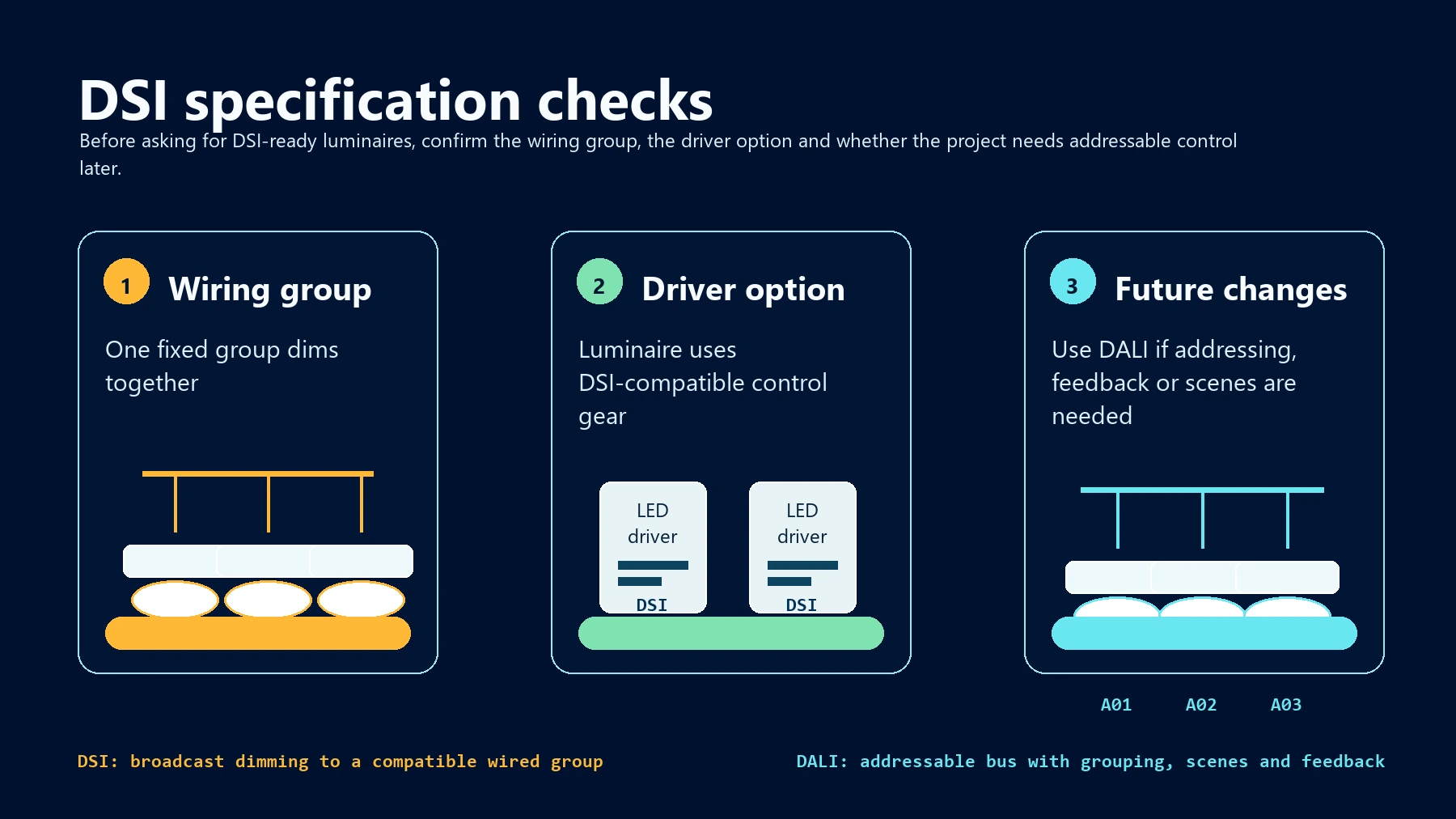
Before specifying DSI on a commercial lighting project, check the details that actually decide whether it can be priced and supplied cleanly.
- Is the existing controller DSI, DALI, SwitchDIM, 1-10V, phase dimming or another system?
- Does the selected luminaire range support the required DSI-compatible driver?
- How many control groups are needed, and are they fixed by wiring?
- Will the space need re-grouping or scene changes after handover?
- Does the project need emergency conversion, self-test or DALI emergency reporting?
- Who is responsible for commissioning and proving the control method?
- Are sensors, daylight response or BMS links part of the control brief?
If those answers are unclear, DSI may still be possible, but it is not ready for pricing as a finished product requirement.
DSI, DALI and Casambi in real project terms
On paper, control protocols can look like a technical preference. On site, they affect wiring, commissioning time, maintenance and who can adjust the lighting later.
| Project condition | Usually worth considering | Reason |
|---|---|---|
| Simple dimmed group with known wiring | DSI or SwitchDIM where supported | The project may not need addressable control |
| Large commercial floorplate | DALI | Addressing and grouping help when zones change |
| Retrofit where control wiring is difficult | Casambi where range support is available | Wireless commissioning may reduce wiring disruption |
| Emergency reporting or centralised test records | DALI emergency-capable arrangement | Emergency control gear and monitoring need to be specified together |
| Small room with local push-button dimming | SwitchDIM where driver support is available | Simple local control may be enough |
This is why Lumenloop treats controls as a product-configuration question, not a final accessory. The same fitting family may need different driver choices depending on whether the job needs fixed output, DALI, DSI, SwitchDIM, Casambi, sensors or emergency options.
Useful next steps for a Lumenloop project
If the project is still at controls-selection stage, start with commercial lighting controls and compare the likely control method against the product type. For wireless control, review Casambi lighting controls. For emergency requirements, check emergency lighting before finalising the driver choice.
Where the fitting type is already known, the next step is usually a product range check. DSI, DALI and SwitchDIM questions often come up around commercial downlights, linear lighting, LED panel lighting and track lighting.
For a quotation or range check, send the product type, quantity, mounting method, controls requirement and emergency requirement through Lumenloop contact. A short project note is enough to start the control-gear conversation.
FAQ
Is DSI the same as DALI?
No. DSI is a simpler digital dimming protocol without individual driver addressing. DALI is addressable and supports individual, group and broadcast control, with two-way communication where the equipment supports it.
Is DSI still used?
Yes, but it is more common as a compatibility or simple grouped-dimming decision than as the first choice for complex new control systems. Many commercial projects now review DALI, Casambi, SwitchDIM or fixed-output control depending on the brief.
Can DSI drivers be replaced with DALI drivers?
Only after checking the driver, controller, wiring and commissioning arrangement. DSI and DALI should not be treated as automatically interchangeable even when some driver terminals or product families support more than one control mode.
Does DSI support emergency lighting testing?
DSI is not an emergency testing protocol. Emergency lighting testing, self-test and DALI emergency reporting depend on the emergency control gear and the monitoring arrangement specified for the luminaire.
What should I send to Lumenloop for a DSI control check?
Send the luminaire type, quantity, existing or proposed control system, preferred dimming method, switching or zoning requirement, emergency requirement and any known product references. That is usually enough to check whether DSI, DALI, SwitchDIM or another control route is more suitable.