
Confirm the 600 × 600 interface and the project ceiling detail.
DALI LED panels
Panel lighting selected with the DALI route visible
Compare current low-glare and direct/indirect panel families without hiding whether DALI is a standard control option or tied to tunable white.
 Lucid · 600 × 600 LG7
Selection principle
Choose the panel and DALI option together
Choosing a DALI panel involves more than checking that DALI is listed. The panel size, output, colour temperature, emergency option and driver controls all need to suit the project. The comparisons below show which families offer standard DALI controls and which use DALI with tunable white.
Check whether DALI is a standard option or part of tunable-white control.
Compare low-glare and direct/indirect approaches.
Keep emergency selection in the same model and controls schedule.
Project selector
Find a suitable DALI panel family
Choose the panel type, DALI option, output and emergency requirement. The selector suggests a suitable family; final quantities and commissioning details remain project-specific.

Current family comparison
Compare the current DALI-capable panels
The controls field shows the published option for each family; it does not assume every DALI configuration is identical.

600 × 600 low-glare panel
Aurora
Low-glare 600 × 600 panel powered by Philips, with published DALI, Casambi and emergency routes.
- Format
- 600 × 600 mm
- Output
- 2,425–4,200 lm
- Power
- 19–32 W
- CCT
- 3000K or 4000K
- Controls
- DALI or Casambi
- Emergency
- Available
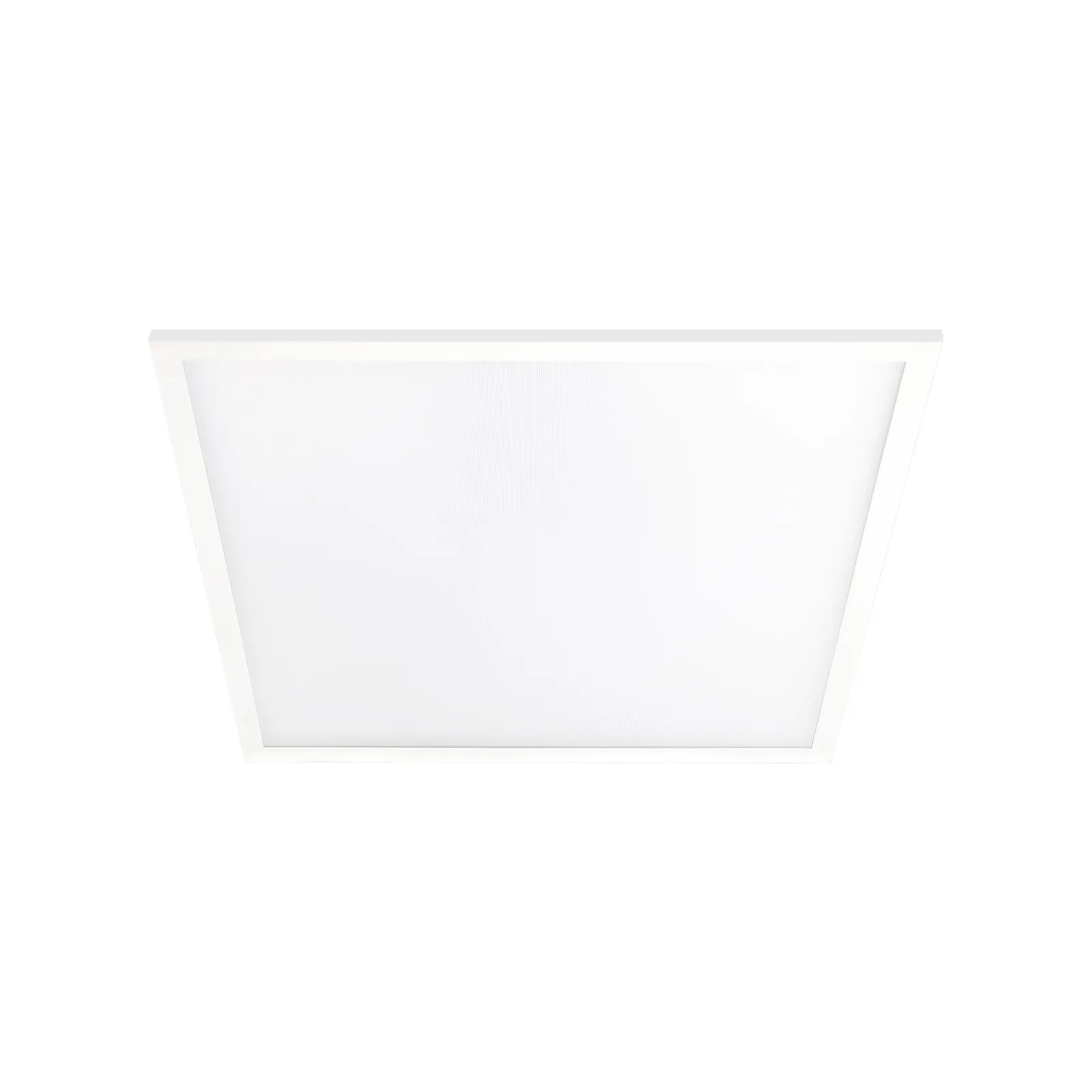
600 × 600 LG7
Lucid
Low-glare panel with a standard DALI, SwitchDIM or DSI option and a compact commercial output range.
- Format
- 600 × 600 mm
- Output
- 2,700–3,900 lm
- Power
- 26–36.5 W
- CCT
- 3000K or 4000K
- Controls
- DALI, SwitchDIM or DSI
- Emergency
- Available

Direct/indirect panel
Luminate
UK-made direct/indirect microprism panel with tunable-white + DALI and wireless-control options.
- Format
- 600 × 600 mm
- Output
- 3,025–5,100 lm
- Power
- 32–47 W
- CCT
- 3000K or 4000K
- Controls
- Tunable white + DALI or Casambi
- Emergency
- Available
Specification guidance
Decisions to settle before the layout is fixed
Each item changes the usable product schedule, so work through them with the ceiling and control drawings in view.
Confirm the ceiling module
Aurora, Lucid and Luminate are recorded as 600 × 600 families. Check the actual grid, trim and installation detail before scheduling.
Name the DALI option precisely
Aurora publishes DALI and Casambi options, Lucid publishes DALI through its ECO option, and Luminate publishes tunable white + DALI or Casambi. Keep those differences visible in the model schedule.
Choose the light distribution
Aurora and Lucid are low-glare modular panels, while Luminate uses a direct/indirect microprism construction. Compare the published photometry for the selected model.
Coordinate emergency and controls
Select the emergency variant with the panel and control option. Do not assume the normal-lighting driver description also defines the emergency testing method.
Questions from project teams
Frequently asked questions
Each answer stays within the information published for the current product families.
Is every panel on this page available with the same DALI option?
No. Aurora and Lucid publish standard DALI routes, while Luminate publishes tunable white + DALI. Confirm the exact driver and control option before ordering.
Are all 600 × 600 panels interchangeable?
No. Confirm the ceiling interface, trim, installation detail and photometry for the selected family before ordering.
Does DALI determine the panel output?
No. Output is a luminaire-model decision. DALI controls the panel; the model, layout and photometry determine the lighting result.
Can emergency lighting use the same panel family?
Each compared family records emergency options, but the exact variant and testing strategy must be confirmed in the project schedule.
Project support
Send us the panel schedule and DALI control brief
We will check the ceiling format, output range, control option and emergency requirement against the current panel families before a proposal is prepared.
- Reflected ceiling plan and panel module
- Required output or lighting calculation inputs
- DALI or tunable-white control brief
- Emergency and testing requirements