
Place the beams
Set the two heads around the required open-area or task coverage, then verify the result in the emergency-lighting calculation.
Emergency lighting selection
Compare the complete current twin-head range for open areas and higher mounting positions, with adjustable heads, three-hour duration and documented emergency product routes.

Two distinct duties
Twin spot emergency lights use two independently directed heads to place emergency illumination where a single fixed optic is less suitable. They are commonly considered for open areas, warehouses, plant spaces and other locations where the emergency-lighting design needs directed coverage.
The current range separates a twin emergency projector with DALI and self-test versions from a high-intensity twin spot with documented 2 × 110 lm output and a wide-beam lens option. The final choice still depends on the emergency-lighting calculation, mounting position and project testing strategy.
Both products have one current base reference in the catalogue. Dimensions, IP rating and other unlisted values should be confirmed against the selected supplier document before the schedule is issued.
Selection checks
Use the emergency-lighting design and site conditions to decide which twin-head route fits the project.
Set the two heads around the required open-area or task coverage, then verify the result in the emergency-lighting calculation.
Confirm wall or surface position, mounting height, access and any physical constraints around the adjustable heads.
Where DALI or self-test is required, keep that requirement aligned with the selected projector version and wider system.
Verify any dimension, ingress or environmental value that is not stated in the current catalogue before ordering.
Complete current range
Each card retains the current base reference and the technical distinctions supported by the catalogue record.
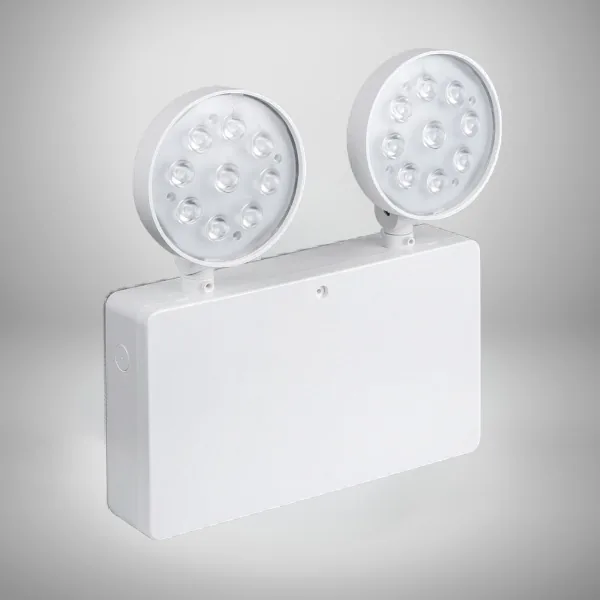
DALI and self-test versions
Twin-head LED emergency projector with two 3 W LED heads, three-hour duration, polycarbonate body, heads and lenses, and documented EN 60598-2-22 compliance.
View Twin Emergency Projector details| Code | Product type | Emergency supply |
|---|---|---|
| TWINEMERGENCYPROJECTOR.001 | Twin-head emergency projector | Integral NiCd batteries |
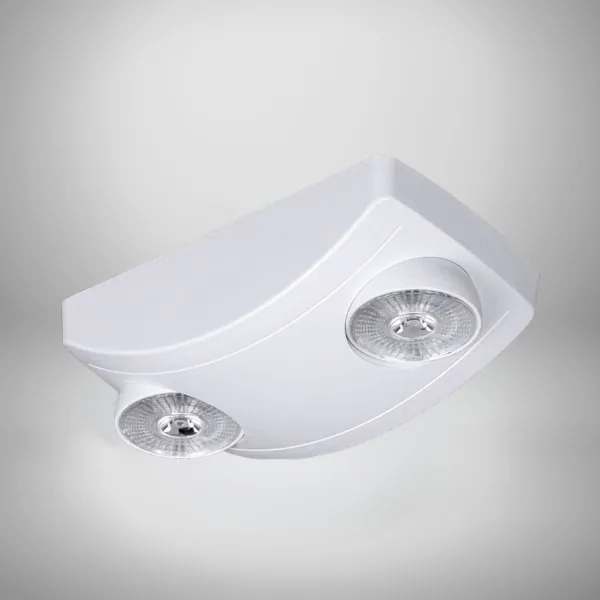
High-intensity adjustable heads
Wall or surface-mounted emergency luminaire with independently adjustable heads, documented 2 × 110 lm output, three-hour duration and a wide-beam lens option.
View High-Intensity Emergency Twin Spot details| Code | Output | Emergency supply |
|---|---|---|
| HIGHINTENSITYEMERGENCYTWINSPOT.001 | 2 × 110 lm | Integral NiMH batteries |
At-a-glance comparison
This comparison stays within the values held in the current product catalogue.
| Family | Mounting | Output or power | Duration | Control or test route | Optic |
|---|---|---|---|---|---|
| Twin Emergency Projector | Emergency projector | 2 × 3 W LED heads | 3 hours | DALI and self-test versions available | Adjustable twin projector heads |
| High-Intensity Emergency Twin Spot | Wall or surface mount | 2 × 110 lm | 3 hours | Confirm against selected emergency system | Independently adjustable heads; wide-beam lens option |
Specification record
Twin spots still need the same disciplined design, testing and handover checks as the wider emergency-lighting scheme.
Record whether the unit serves an open area, a specific hazard or another defined emergency-lighting duty.
Confirm the surface, height, orientation and safe access for installation, adjustment and future maintenance.
Coordinate both adjustable heads with the calculation so coverage remains intentional after installation.
Both current records state three-hour duration; retain that requirement in the luminaire schedule.
Confirm manual, self-test or DALI-related requirements across the complete emergency-lighting system.
Keep product data, photometry, commissioning records and test information with the handover package.
Frequently asked questions
Answers based on the two current Lumenloop catalogue records.
Two: Twin Emergency Projector and High-Intensity Emergency Twin Spot.
Yes. Three-hour emergency duration is stated for both current product records.
The High-Intensity Emergency Twin Spot record states 2 × 110 lm. The projector record states 2 × 3 W LED heads but does not state lumen output.
The Twin Emergency Projector record explicitly lists DALI and self-test versions. Confirm the exact version and emergency-system compatibility before ordering.
The High-Intensity Emergency Twin Spot explicitly states independently adjustable heads. The projector is described as having twin adjustable LED projector heads.
Send the emergency-lighting layout, mounting height, required coverage, testing strategy and any environmental constraints.
Project support
Share the plan, mounting positions, required emergency duties and testing strategy. Lumenloop can help turn the design into a coordinated product schedule.