
Total cost
of ownership.
The purchase price is only the beginning.
A fitting costs money to buy, to run and to maintain. A longer-life driver can mean fewer replacements, fewer site visits and a lower cost over time.
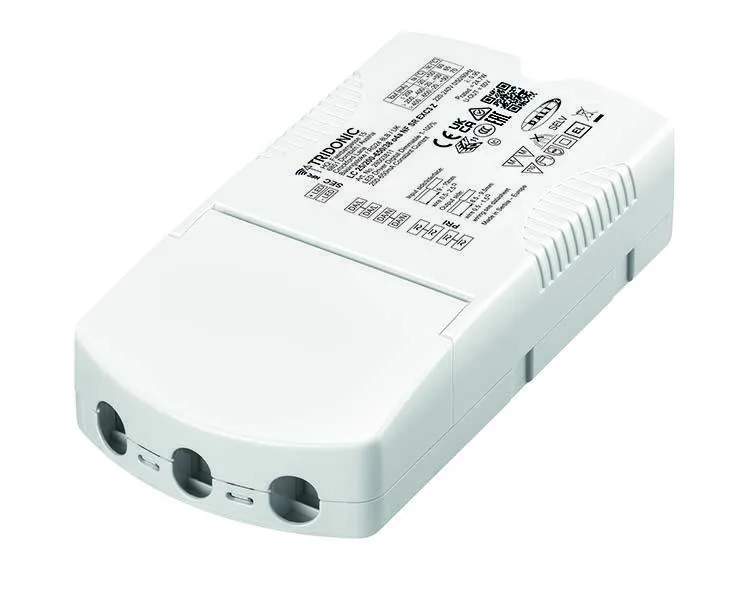
Tridonic EXCITE nominal driver lifetime.
*Model and thermal conditions apply ↗
Why the driver matters
The LEDs can outlast
the driver.
A working LED still needs a working power supply.
The driver converts mains electricity into the controlled power the LEDs need. If it stops supplying that power, the light can go out even while the LEDs themselves remain serviceable.
Driver electronics are a recognised source of abrupt lighting failures. That makes driver selection a practical maintenance decision, not just a line on the specification.
One component can interrupt the light.
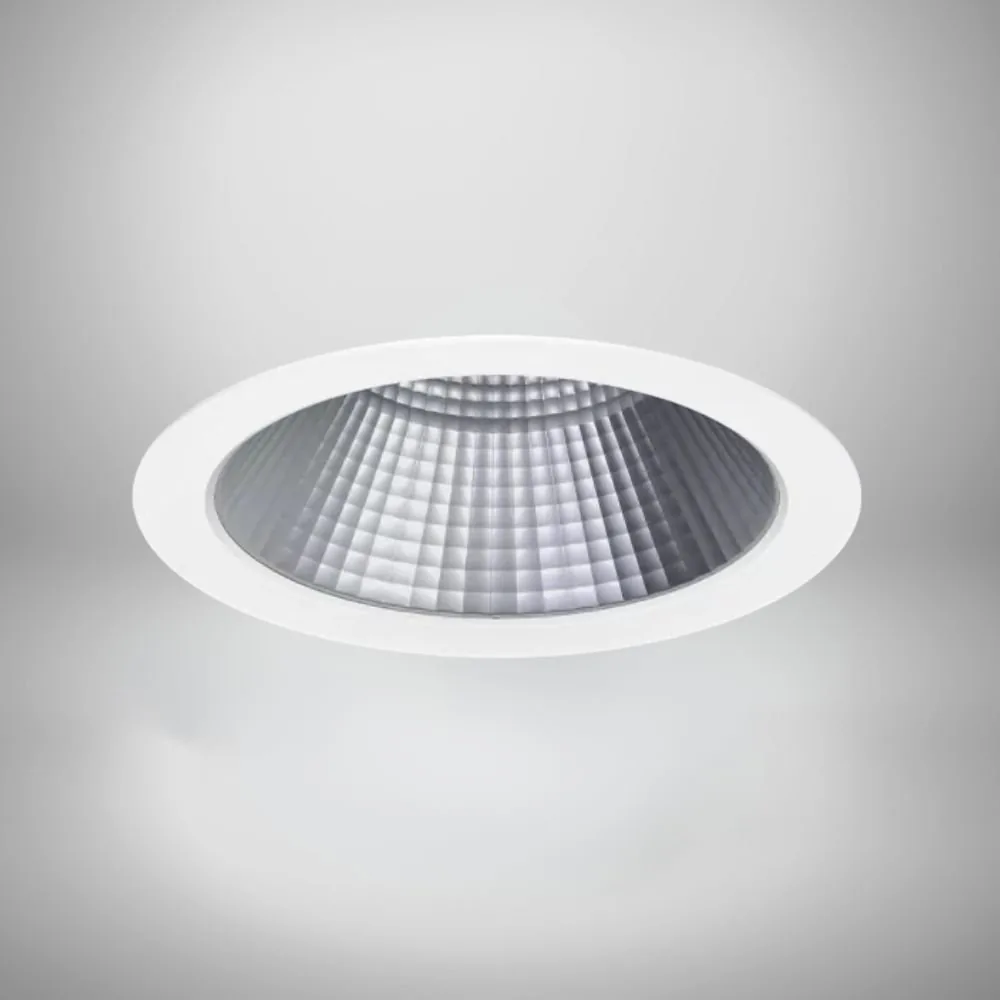
The system works together.
The driver and LEDs both need to function for the fitting to deliver light. A long-life LED rating alone does not describe the reliability of the whole system.
Illustration of the power path, not a confirmed driver–luminaire pairing or a prediction of when a component will fail.
Why we specify
Tridonic and Philips.
We use established driver brands such as Tridonic and Philips for relevant Lumenloop configurations, selecting the model around its published lifetime, LED load and operating conditions.
A suitably rated longer-life driver can keep the luminaire operating for longer before a driver replacement is needed. For you, that can mean fewer electrician call-outs, less need for access equipment and less disruption to an occupied space.
The exact driver and control option are confirmed for the selected fitting. Thermal design and installation conditions matter alongside the component choice.
Technical background +
The DOE / LED Systems Reliability Consortium lifetime guide, 2014, section 3 identifies driver electronics as an important abrupt-failure mechanism. Its findings do not establish one failure order for every luminaire.
Signify’s white paper on LED driver reliability explains how driver design, loading and temperature affect system life. The EXCITE study below uses the selected model’s own datasheet.
01 / The ownership model
What does lighting cost
over its working life?
Compare the money spent on the same number of luminaires: purchase and installation, electricity, then replacement drivers and the labour to fit them.
Illustrative driver-service scenario. Prices, power and service intervals are editable assumptions, not quotations or competitor averages. Driver lifetime is not the lifetime of the complete luminaire.
Cumulative ownership cost
Total spent over 20 years
Costs for 100 luminaires, added up from day one. A lower line means less money spent.
 Solid teal · longer-life driver scenario
Equal electricity costs
Dots: buy and installThe two dots at year zero are the initial outlay.
Rise: electricityRunning costs accumulate each year.
Step: driver serviceThe square marks the added cost of parts, labour and access.
Where the money goes
Purchase and installation + electricity + planned driver service = total spent.
| Cost | Lumenloop scenario | Generic scenario |
|---|---|---|
| Purchase + installation | £14,000 | £9,500 |
| Energy | £49,000 | £49,000 |
| Driver service | £0 | £12,000 |
| Total | £63,000 | £70,500 |
Why does the dotted line jump?
This example budgets for replacing the drivers in all fittings together. It does not assume the complete luminaires are replaced or that every driver fails at the same time.
Illustrative saving with Lumenloop
£7,50010.6% lower modelled costOne fewer planned driver service across 100 luminaires over 20 years.
Where the cost goes
Calculation method, assumptions & cost table +
Total = purchase + initial installation + electricity + planned driver service. Electricity = quantity × input watts ÷ 1,000 × annual hours × years × tariff. Each service = quantity × (parts + labour and access).
The model assumes a full-population driver service at each entered interval strictly before the study ends. No service is charged exactly at the end of the study. Actual failures are distributed over time; these steps are a budgeting scenario, not a reliability prediction.
All default commercial inputs are illustrative. The 100,000-hour driver service assumption requires model-specific thermal verification. The 50,000-hour generic interval is an editable reference, not a market average or a claim about a named competitor. Parts and labour costs must reflect the actual service strategy.
Constant prices and operating patterns; undiscounted costs excluding VAT. No allowance for inflation, financing, residual value, unscheduled failures, LED/module or control replacement, emergency batteries, cleaning, disposal or business disruption. This is a scoped ownership estimate, not a complete project quotation. No dimming savings are assumed.
02 / Specify the driver
Long service starts
with the components.
Tridonic EXCITE.
Up to 100,000 hours nominal lifetime.
If a driver needs replacing, there is a cost for the part and for getting an electrician to the fitting. Specifying a longer-life driver can reduce how often that work is needed. The driver, LED load and operating temperature must be assessed together.
Ask us to assess an EXCITE driver option for your selected Lumenloop luminaire. Driver compatibility and the complete luminaire specification are confirmed together.
Read the reference datasheet ↗Same driver.
Different operating conditions.
At ta 40°C / tc 60°C, the reference datasheet lists >100,000 hours.
LC 25W 200–650mA 38V o4a NF SR EXC3. Datasheet 07/23, §2.1: less than 10% failure probability under reference conditions. The ta/tc relationship depends on the luminaire. These two documented points are not an interpolation model.
The service perspective
Every visit has a cost.
Labour, access equipment and replacement parts can outweigh the initial saving. Plan for the installation you will actually maintain.
Each marker is a planned service of all fittings, not a predicted failure date. This timeline follows the editable cost model above.
Fewer call-outs
Avoiding a driver replacement can also avoid fault-finding, an electrician’s time and the cost of reaching the fitting. The benefit is greater where access is difficult.
Less disruption
Lighting maintenance can mean moving desks, clearing a retail area or arranging an out-of-hours visit. Fewer interventions can mean less interruption for the people using your building.
Keep more of the fitting
Where the construction allows, a serviceable driver can be replaced while retaining the luminaire body and other working parts. Confirm access and compatible replacements when specifying.
03 / Beyond the driver
What does L90/B10 mean
for LED lighting life?
The driver is the power supply for the LEDs. Its lifetime describes the reliability of that component. Lumen maintenance is different: it describes how much light the LEDs still produce as they age.
- L90
- The threshold of 90% of initial light output at the stated operating hours and conditions.
- B10
- No more than 10% of the specified population is expected to fall below that maintained-output threshold. This is not a declaration that 10% of complete fittings will fail.
- System
- Confirm driver life, light output, temperature and controls for the exact configuration. An upgraded driver does not extend this L90 rating automatically.
Record the complete L/B rating, rated hours, temperature and configuration. Establish whether the declaration covers the LED module or luminaire; assess driver life, abrupt failures, emergency batteries and warranty separately. Rated hours are not a switch-off date or a guaranteed replacement interval.
View the Void datasheet ↗Before you specify
What does longer life
mean for your building?
How can a large lighting project reduce replacement cost and disruption?+
Compare purchase, installation, electricity, maintenance, replacement parts, access and disruption over the same project period. Use luminaire input power, operating hours and the same tariff for each option. Include labour, access equipment and making good, with work outside occupied hours where required. Confirm serviceable components and compatible replacement availability; record replacement assumptions separately from lifetime ratings.
For existing installations, Renew & Reuse assesses a sample fitting before refurbishment or LED conversion is agreed. Retention depends on condition, compatibility and the project requirements.
Does a failed driver mean replacing the whole fitting?+
Not necessarily. If the driver is accessible and a compatible replacement is available, the working LEDs and luminaire body may be retained. The electrician needs to diagnose the fault and confirm the correct replacement. Serviceability is a separate benefit from a long lifetime rating.
Does 100,000 hours mean 25 years without maintenance?+
At 4,000 operating hours a year, 100,000 hours is arithmetically 25 years. It is not a promise of 25 maintenance-free years: the rating has specified thermal and reliability conditions, and other parts of the lighting system may need attention sooner. It is also separate from the warranty period.
What should I compare alongside the initial price?+
Ask for the exact driver model, its lifetime at the expected operating temperature, the luminaire’s maintained light output, and how the driver can be accessed and replaced. Include labour and access in the cost comparison, and check whether the warranty covers those costs as well as the part.
Make the comparison project-specific
Specify for the years ahead.
Send us your lighting schedule or the alternative you are considering. We will help compare the specification, driver options and whole-life costs.
Request a whole-life comparison ↗