
LED and lighting controls can reduce electricity use, but there is no reliable single percentage for every office, school or retail space. A useful estimate begins with the existing load and operating pattern, then separates the savings from a lower-load LED installation from any additional reduction expected from controls.
That approach is more useful than an “up to” claim. It shows where the result comes from, lets a facilities team compare options, and gives a clear list of assumptions to review after installation. It also avoids treating controls as an add-on that will deliver the same result in a constantly occupied office, an intermittently used classroom and a retail sales floor.
Start with the two parts of the saving
The first part is the change in electrical load. Compare the existing complete luminaires with the proposed complete luminaires, including the associated control gear where that information is available. The second part is the change in how long, and at what output, the lighting runs. Controls affect this second part.
| Element | What to measure | What changes it |
|---|---|---|
| Existing annual energy | Existing installed load × annual operating hours | Existing fitting quantity, watts and actual use. |
| LED annual energy | Proposed installed load × annual operating hours | Complete luminaire output, optics, driver and layout. |
| Controls adjustment | The agreed reduction in unnecessary run time or output | Occupancy, daylight, schedules, zoning, setpoints and commissioning. |
| Cost saving | Annual kWh saved × the site tariff | Actual contract tariff and the same measured operating period. |
| Carbon comparison | Annual kWh saved × stated conversion factor | Reporting year, factor and accounting boundary. |
The core calculation is straightforward:
Annual lighting electricity (kWh) = installed lighting load (kW) × annual operating hours
Use the same operating period for the before-and-after comparison. Then document any change in hours or output expected from controls. If the project has interval data, use it to test the assumed hours. If it does not, use a conservative operating schedule and label it as an estimate.
A useful appraisal can show separate cases for LED replacement with existing switching, LED replacement with agreed control zones, and controls modelled at a cautious operating assumption. Retain the same tariff and reporting period in each case. This lets a decision-maker see which reduction comes from the luminaire upgrade and which depends on successful commissioning and user adoption.
Why complete-luminaire evidence matters
It is tempting to compare only a lamp’s quoted efficacy or wattage. In a commercial installation, however, the fitting, light source and control gear work as a system. The UK Energy Technology List’s efficient white lighting unit criteria define the product as a luminaire with its source or sources and associated control gear, and assess performance at circuit power.
This matters particularly where an existing fluorescent fitting is being considered for an LED conversion. Compatibility with the fitting, control gear, wiring, emergency provision and proposed control method must be established for the selected product and installation. Do not assume that any LED tube or lamp is a universal substitute, or that a quoted lamp life is a project-life forecast.
Choose controls for the space and its use
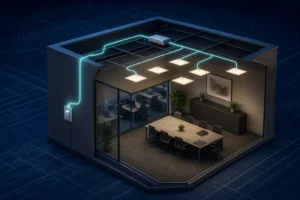
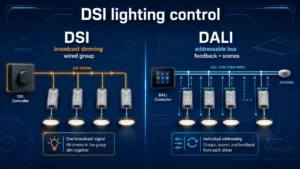
Controls should respond to a recognisable source of wasted run time or excess output. The Energy Technology List identifies presence detectors that switch off or dim lighting after an area becomes unoccupied, and daylight detectors that automatically dim electric lighting as daylight is available. It also recognises central and network control units that manage these functions across an installation.
Those definitions explain what a control can do; they do not prove a fixed building-wide saving. Sensor position, detection range, daylight direction, local override, cleaning, maintenance, zoning and commissioning all affect the result. A poorly chosen setting can also frustrate users, so the operational brief is as important as the device.
| Space type | Evidence to collect | Control question |
|---|---|---|
| Open-plan office | Desk occupancy, perimeter daylight, work patterns and screen locations. | Can zones follow daylight and use without creating nuisance switching? |
| Meeting rooms | Booking pattern, actual vacancy periods, presentation use and local override needs. | Should presence response dim first, switch off, or allow manual scene selection? |
| Classrooms and halls | Timetable, daylight, teaching activities, cleaning and community use. | Can switching support the teaching space while avoiding unnecessary out-of-hours operation? |
| Retail sales floor | Trading hours, display zones, daylight, cleaning and security requirements. | Which areas need constant presentation light and which can follow a schedule or daylight? |
| Circulation and welfare areas | Traffic pattern, safety needs and emergency arrangements. | What minimum operating condition is appropriate when the area is vacant? |
For the product and system side of this decision, including DALI, Casambi and sensor-ready luminaire options, visit commercial lighting controls. That page owns the controls specification subject; this article is concerned with making the savings estimate transparent.
Use a repeatable estimation method
- Survey the baseline. List fitting types, quantities, installed watts, zones, control gear, emergency arrangements and normal operating hours.
- Define the lighting outcome. Identify the task, maintained-light, glare, mounting, distribution and appearance requirements before selecting a proposed wattage.
- Calculate LED load reduction. Compare existing and proposed complete-luminaire loads over the same annual hours.
- Model controls separately. State whether the assumption is for vacancy, daylight, scheduling or another agreed strategy, and why the chosen zones support it.
- Apply the actual tariff. Saved kWh multiplied by the site’s electricity tariff gives the energy-cost comparison.
- Review after commissioning. Check settings, operating schedules and measured consumption where available; revise the estimate if the space is used differently from the original brief.
For commercial offices, the office lighting energy saving calculator provides a planning estimate for annual kWh, running cost, CO2e and energy-only simple payback. It deliberately treats the control option separately from luminaire load and states that the result is not a lighting design or quotation. Use it to test a documented office scenario, not to transfer an office result to a school or retail project.
Do not treat simple payback as the entire business case. Record installation access, disruption, testing, maintenance implications and any controls commissioning allowance separately, because they may affect the decision even though they are not part of an energy-only calculation. Keep the assumptions visible so a later quote can replace them with project-specific costs.
Apply the method without over-claiming by sector
Offices
Office savings usually turn on the current installed load, desk occupancy, daylight at the perimeter, meeting-room vacancy and the tariff. The proposed solution still needs to support task work and manage glare. For office product selection and lighting requirements, see commercial office lighting.
Schools
Timetables do not describe every operating hour. Halls, sports spaces, cleaning and community use can materially change the annual baseline. Treat classrooms, circulation and larger shared spaces as separate zones where their use differs. A control proposal should reflect teaching activity and safe operation, not simply a percentage copied from a different school.
Retail
Retail projects combine general, accent and display lighting, each with different operating needs. Display lighting should not be assumed to have the same control pattern as stock areas, staff rooms or circulation. Assess visual merchandising, trading hours, cleaning, security and daylight by zone. Do not claim sales or dwell-time effects without project-specific, independently supportable evidence.
Report carbon with the current UK factor
Carbon is best calculated from saved kWh using a current factor with the reporting method made clear. The DESNZ 2026 greenhouse-gas conversion factors support UK activity-based reporting from, among other inputs, purchased-electricity kWh. They are updated annually, so avoid carrying forward a fixed “carbon saved per 1,000 kWh” statement from an earlier article.
A sound result identifies the factor year, whether the figure is CO2 or CO2e, the electricity boundary used and whether the calculation is an estimate or measured outcome. This is particularly important when a business will use the figure in environmental reporting or procurement evidence.
From an estimate to a commercial scope
Once the baseline and controls assumptions are visible, the next conversation can be about the actual installation: fitting condition, ceiling and access, lighting requirements, emergency provision, control compatibility and commercial scope. For retrofit products, controls, emergency options and quotation requirements, see commercial LED lighting upgrades.
For England projects, check the requirements that apply to the particular building work. The government’s Approved Document L, Volume 2 gives guidance on the energy-efficiency requirements for non-domestic buildings. It is not a substitute for confirming the compliance position or the detailed design of a specific installation.