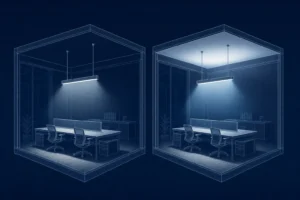

Maintained emergency lighting is illuminated during normal operation and remains on when the normal supply fails. Non-maintained emergency lighting normally stays off and illuminates only during a supply failure. The right choice depends on risk, occupancy and how the space is used—not on a blanket preference for one type.
Maintained versus non-maintained: the difference
| Type | Normal supply available | Normal supply fails | Typical role |
|---|---|---|---|
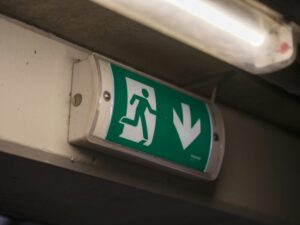
| Maintained | Illuminated | Continues from its emergency supply | Exit signs, public venues and locations where the fitting serves a normal-lighting function |
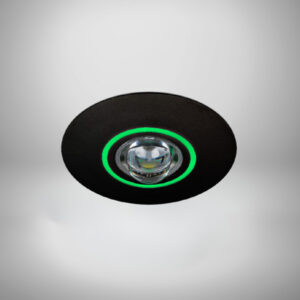
| Non-maintained | Off | Illuminates from its emergency supply | Dedicated escape lighting in premises that normally have adequate electric lighting |
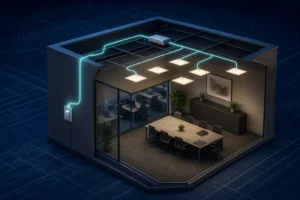
| Combined | Normal lamp or LED function available | Dedicated emergency component operates | Projects needing both general and emergency functions in one assembly |
When maintained emergency lighting makes sense
Maintained signs remain legible while the building is operating. Maintained luminaires may also be appropriate where the normal lighting is deliberately dimmed, where people are unfamiliar with the building, or where loss of light could cause confusion before occupants recognise a supply failure.
- Places of entertainment, hospitality and assembly.
- Escape-route signs that must remain conspicuous during normal use.
- Areas with variable or low normal-lighting levels.
- Premises where occupants may need immediate visual orientation.
When non-maintained emergency lighting may be appropriate
Non-maintained fittings are common in offices, industrial spaces and other premises where the normal lighting is on whenever people are present. They remain charged and monitored, then illuminate automatically when the normal supply to the relevant area fails.
Non-maintained does not mean untested. The battery, charger, lamp or LED, changeover operation and duration still require inspection and testing. Self-test functionality can simplify evidence gathering, but it does not remove the need for a managed maintenance regime.What the UK design process should check
- Start with the fire-risk assessment. Confirm escape routes, changes of level, final exits, open areas, high-risk task areas and fire-safety equipment.
- Define the failure condition. Emergency lighting must respond to failure of the normal lighting supply serving the relevant area, not only to a whole-building outage.
- Select the operating mode. Decide maintained, non-maintained or combined operation for each location.
- Coordinate signs and luminaires. Exit-sign visibility, viewing distance, mounting and direction must work with the route lighting.
- Confirm duration and controls. Battery duration, rest mode, inhibition and test facilities must suit the premises and management plan.
- Commission and record. Produce drawings, completion information, test records and a logbook for the responsible person.
Current standards to reference
BS 5266-1:2025 provides UK guidance on emergency-lighting systems. BS EN 1838:2024 covers the lighting requirements for escape and standby purposes. Product selection should also use the relevant luminaire safety standard and current manufacturer information.
Standards support the design; they do not replace the legal fire-safety duties, risk assessment or competent professional judgement for the premises.
Common specification mistakes
- Choosing every fitting as maintained without considering controls, energy and actual use.
- Using only non-maintained fittings where exit information must be continuously visible.
- Testing only a building-wide power cut rather than local circuit failure.
- Leaving final exits, external escape routes or changes of level outside the design.
- Specifying a nominal duration without checking evacuation and reoccupation strategy.
- Failing to hand over drawings, certificates and a usable test log.
Frequently asked questions
Can a maintained fitting be switched?
Many maintained products can have their normal-lighting function switched while the emergency circuit remains permanently supplied. The exact wiring and control arrangement must follow the product instructions and design.
Are exit signs maintained?
Exit signs are commonly maintained where they must be visible whenever the premises are occupied. The risk assessment and applicable guidance determine the requirement.
How often should emergency lighting be tested?
A planned routine of functional checks and full-duration testing is required, with results recorded. The responsible person should follow the current standard, system instructions and site fire-safety procedure.
Turn the risk assessment into a practical system
Compare emergency luminaires and estimate the likely number of fittings before a competent designer confirms the final layout.
Explore emergency lightingUse the emergency lighting calculator