Emergency escape lighting helps people find their way out when the normal lighting fails. For commercial and other non-domestic premises, the fire risk assessment should identify which routes and areas need lighting, who may use them, and how long the system needs to operate.
UK emergency lighting duties
In England and Wales, Article 14 of the Regulatory Reform (Fire Safety) Order 2005 requires emergency routes and exits that need illumination to have adequate emergency lighting if the normal lighting fails. Article 17 requires relevant fire safety equipment and facilities to be maintained in efficient working order and good repair. Scotland and Northern Ireland have separate fire safety legislation and guidance for non-domestic premises.
- England and Wales: Regulatory Reform (Fire Safety) Order 2005
- Scotland: non-domestic fire safety guidance
- Northern Ireland: business fire safety guidance
Which emergency lighting standards apply?
- BS 5266-1:2025 is the UK code of practice for emergency lighting in premises.
- BS EN 1838:2024 covers lighting performance, including illuminance, duration and the visibility of safety signs.
- BS EN 50172:2024 covers emergency escape lighting systems, including installation, verification, handover, testing and maintenance.
Where is emergency escape lighting needed?
Consider exit doors, stairs, changes of direction or level, corridor junctions and the area outside final exits. People also need to be able to see escape signs, fire alarm call points and firefighting equipment. The assessment should also consider open areas people cross to reach an exit and any high-risk tasks that must be made safe before people can leave.
BS EN 1838:2024 specifies a minimum of 1 lux at floor level across the assessed part of an escape route, with defined edge exclusions. Where open-area lighting is required, the minimum is 0.5 lux at floor level in the clear core area, excluding a 0.5 m perimeter strip. An escape route through an open area has its own requirements.
For ceiling-mounted signage, check the mounting and specification options for our ceiling-mounted emergency exit sign.
Maintained and non-maintained lighting
Maintained emergency luminaires can operate during normal use and continue on the emergency supply when normal lighting fails. Non-maintained luminaires light only when the normal supply fails or is interrupted for a test. BS EN 1838:2024 calls for maintained emergency safety signs where people are unfamiliar with the premises.
How long should the lights stay on?
BS EN 1838:2024 sets a minimum duration of one hour for escape route and open-area emergency lighting. The premises may need a longer duration. Three-hour systems are recommended where people may remain in the building during a power failure or where it may need to reopen before batteries are fully recharged. Check the premises’ evacuation and reoccupation arrangements when specifying duration. Warwickshire Fire and Rescue Service guidance
How often should emergency lighting be tested?
- Monthly: carry out a short functional test to check that each emergency luminaire and illuminated exit sign operates on its emergency supply.
- Annually: test the system for its full rated duration. Plan the test for a time of low risk and account for reduced battery capacity while the system recharges.
Keep a log of tests, faults and corrective work. The Home Office guide for offices and shops explains routine testing and record keeping.
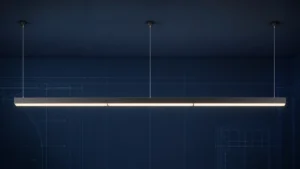
See Lumenloop emergency lighting for luminaire and exit sign options.