Warehouse LED lighting: how to specify the right system
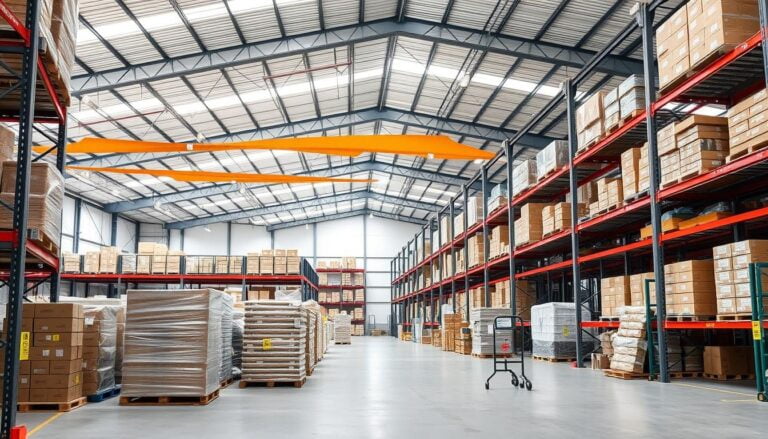
Good warehouse lighting is not simply a matter of installing brighter high bays. The design needs to support the tasks taking place, reveal people and vehicles clearly, limit glare, reach the faces of racking and provide dependable illumination across loading, picking and circulation areas.
The right solution starts with the building, the layout and the operational risk. Mounting height, aisle geometry, stock locations, vehicle routes, working hours, daylight and maintenance access all affect the choice of luminaire and controls.
What warehouse lighting needs to achieve
A warehouse can contain several visually different workplaces under one roof. Treating them as a single open area can leave important tasks underlit while wasting energy elsewhere.
| Area | Typical visual need | Design priority |
|---|---|---|
| Storage aisles | Reading labels and locating stock at different heights | Useful vertical light on racking, controlled glare and optics suited to the aisle |
| Picking and packing | Frequent handling, checking and reading | Task-appropriate maintained illumination, good uniformity and suitable colour rendering |
| Despatch and loading | Movement of people, pallets and vehicles | Clear visibility, reduced contrast at entrances and careful control of shadows and glare |
| High-bay open areas | Safe general movement and stock handling | Efficient light delivery from the mounting height without excessive brightness at the luminaire |
| External yards | Vehicle manoeuvring and pedestrian awareness | Suitable coverage with minimal spill, dazzle and dark transitions |
| Cold, dusty or damp zones | Reliable operation in a demanding environment | An appropriate IP rating, temperature range, materials and maintenance plan |
Lighting levels: start with the task and risk
There is no single illuminance figure that is correct for every warehouse. A design should use current workplace-lighting guidance, including the relevant parts of BS EN 12464-1 and the SLL Code for Lighting, together with the site risk assessment and the actual task.
The specification should record more than an average lux value. Maintained illuminance, uniformity, glare, colour rendering and the balance of horizontal and vertical light can all affect visibility. Allowance is also needed for ageing and dirt so the installation continues to meet the brief between planned maintenance visits.
A lighting calculation based on an accurate layout is the practical way to test the proposal. Racking, mounting positions and obstructions should be modelled, and results should be reviewed on the relevant working planes rather than only across an empty floor.
High bays, linear fittings or LED battens?
The luminaire format should follow the space rather than a generic warehouse label.
- High-bay luminaires suit taller open areas where controlled output and an appropriate beam distribution can cover the working plane efficiently.
- Linear high-bay or continuous-row systems can align well with long aisles and make it easier to direct light along racking faces.
- LED battens are often appropriate at lower mounting heights, in ancillary stores, service areas and beneath mezzanines.
Output alone is a poor basis for comparison. Review the photometric file, optical distribution, glare, efficacy, thermal performance, driver and control compatibility, emergency options, ingress protection and access for maintenance.
Controls and energy use
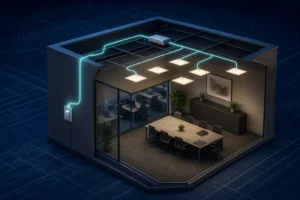
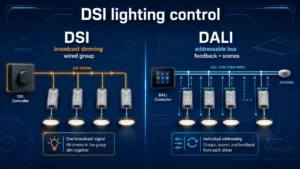
Warehouses often have long operating hours but uneven occupancy. Zoned controls can reduce unnecessary use without compromising a safe working environment.
- Use presence detection in intermittently occupied aisles and secondary areas.
- Group luminaires so an occupied route remains visually comfortable rather than creating isolated pools of light.
- Use daylight-linked dimming where rooflights or perimeter glazing provide a useful and predictable contribution.
- Set appropriate fade times and minimum levels for the work pattern, vehicle movement and local risk assessment.
- Commission the controls after installation and give the facilities team a clear record of zones and settings.
For an early indication of the design inputs, use our warehouse lighting calculator. A project calculation and site-specific control strategy should follow before equipment is selected.
Safety around vehicles, doors and loading bays
HSE guidance requires workplace lighting to be suitable and sufficient. In warehouse traffic areas, the design should help drivers and pedestrians see routes, hazards and each other without glare or dazzle.
Pay particular attention to loading bays, crossings, corners, ramps and doorways. Sudden changes between bright and dark areas can make it harder to see when entering or leaving a building. Luminaires should be positioned and aimed so they do not shine into a driver’s eyes, and failed or dirty fittings should be dealt with promptly.
Emergency lighting and maintenance
Emergency lighting is a separate life-safety requirement and should be designed to the applicable standards and fire-risk assessment. Escape routes, open areas, changes of level, fire-fighting equipment and high-risk task areas may need specific treatment. See our emergency lighting guidance for the wider design and testing context.
Maintenance planning belongs in the original specification. Record how drivers, sensors and emergency components will be accessed; how fittings will be cleaned; what spares are available; and how failed equipment will be identified. A nominal life figure is not a promise that every component will operate for that period in every warehouse condition.
Warehouse lighting survey and specification checklist
- Map each operational zone, task, shift pattern and pedestrian or vehicle route.
- Confirm mounting heights, racking dimensions, obstructions, rooflights and environmental conditions.
- Set the maintained lighting criteria for each task using current guidance and the risk assessment.
- Model the proposed luminaires with current photometric data and review horizontal, vertical, uniformity and glare results as relevant.
- Develop the control zones and behaviour around real patterns of occupation and daylight.
- Coordinate normal, emergency and external lighting, including transitions at entrances and loading areas.
- Check access, cleaning, component replacement, warranty and product-support arrangements.
- Commission the installation and retain the calculation, settings, product data and test records.
For a survey, lighting calculation and product schedule, visit our warehouse and industrial lighting service or speak to the Lumenloop team.
Warehouse LED lighting frequently asked questions
How bright should warehouse lighting be?
The required maintained illuminance depends on the task, the level of detail, the people using the space and the associated risk. Use the appropriate workplace-lighting guidance and verify the proposed layout with a lighting calculation rather than applying one figure to every zone.
Are high-bay LED lights suitable for every warehouse?
No. High bays suit many tall, open spaces, but narrow aisles, lower ceilings, mezzanines and task areas may need linear luminaires, battens or a mixed solution with different optics.
Can sensors be used in warehouse aisles?
Yes. Presence detection can work well in intermittently occupied aisles, provided the detection pattern, grouping, timing and minimum level suit the movement of people and vehicles.
What information is needed for a warehouse lighting design?
A designer will normally need an accurate plan, mounting heights, racking layout, task and shift information, environmental conditions, daylight openings, control requirements, emergency-lighting information and any site-specific safety constraints.