
BS EN 17037 is the European standard for daylight in buildings. It gives designers a consistent way to assess whether occupied rooms receive enough daylight, offer an adequate view out, admit useful sunlight and control glare.
What does BS EN 17037 cover?
The standard applies to regularly occupied spaces and organises daylight quality around four subjects. These criteria should be considered together because a large glazed area can improve daylight availability while also increasing glare or solar exposure.
Daylight provision
How much useful natural light reaches the occupied area over time.
View out
Whether occupants can see external features through a clear opening from relevant positions.
Sunlight exposure
Whether selected spaces receive a meaningful period of direct sunlight.
Glare protection
Whether openings and shading limit disturbing brightness when daylight is strong.
Daylight factor and the newer annual approach
The traditional daylight factor compares indoor illuminance with simultaneous unobstructed outdoor illuminance under a standard overcast sky. It is simple and familiar, but it does not describe changing sun position, orientation, local climate or the timing of daylight during occupied hours.
BS EN 17037 supports climate-based assessment using illuminance targets across a proportion of the reference plane and a proportion of daylight hours. National annexes and project requirements can affect the exact method and values, so the current UK adoption and the agreed design brief must be checked.
A practical daylight assessment workflow
- Define the occupied spaces. Record room use, working plane, occupied hours and any areas excluded from assessment.
- Model the real context. Include orientation, window geometry, glazing transmission, reveals, external obstructions and permanent shading.
- Choose the declared method. Agree whether the planning, certification or employer's requirements call for daylight factor, climate-based modelling or both.
- Check all four daylight qualities. More glass is not automatically better if it damages visual comfort or increases cooling demand.
- Coordinate electric lighting. Daylight-responsive controls should dim or switch luminaires without leaving deep-plan areas underlit.
- Document assumptions. Simulation results are only meaningful when material properties, blinds, furniture and calculation settings are transparent.
How daylight and electric lighting should work together
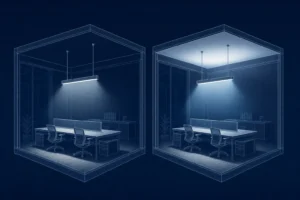
Daylight is variable. A robust office scheme provides sufficient electric light on dull days and after dark, while controls reduce output near windows when daylight is available. Zoning should follow the daylight distribution rather than treating the complete floorplate as one circuit.
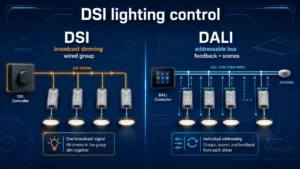
For offices, the daylight study should be coordinated with the electric-lighting design, display-screen locations and glare review. Explore our office lighting solutions, use the office lighting calculator for an early requirement estimate, and review commercial lighting controls for daylight-linked zoning.
Common BS EN 17037 mistakes
- Quoting a daylight-factor percentage without defining the assessed area.
- Ignoring neighbouring buildings, deep reveals or realistic glazing transmission.
- Optimising daylight provision while overlooking glare and view.
- Assuming blinds are always open for daylight and always closed for glare.
- Leaving the electric-lighting and controls strategy until after the façade is fixed.
Frequently asked questions
Is BS EN 17037 mandatory?
Its use depends on the project brief, planning conditions, procurement requirements and other applicable guidance. When it is specified, the assessment method and target level should be agreed at the outset.
Does BS EN 17037 replace daylight factor?
It broadens daylight assessment and supports climate-based methods. Daylight factor is still used in some UK workflows, but it should not be presented as the whole standard.
Can electric lighting compensate for poor daylight?
Electric lighting can provide required task illumination, but it cannot create a view out or the temporal qualities of daylight. The two systems should be coordinated, not treated as interchangeable.
Coordinate daylight with the office lighting brief
Turn the daylight model into practical luminaire zones, controls and an electric-lighting proposal for occupied conditions.
Explore office lightingPlan lighting controlsReference: Buildwise overview of EN 17037. Final design should be checked against the complete current standard, its UK adoption and project-specific requirements.