
FAQ
What is the WELL Building Standard?
The WELL Building Standard is a global benchmark for healthy buildings and communities. It was established by the International WELL Building Institute (IWBI). It focuses on promoting health and wellness through various features, including lighting.
Why is light important in the WELL v2 standard?
Light is crucial for regulating human circadian rhythms, affecting mood, productivity, and sleep patterns. Proper light exposure enhances alertness and improves cognitive function. It also supports healthy sleep-wake cycles. WELL v2 highlights the need for lighting design that aligns with human biological needs.
What are the key lighting concepts and features in WELL v2?
WELL v2 addresses various lighting aspects, including circadian lighting design (L03), glare control (L04), electric light quality (L07), and flicker management. It provides specific requirements and optimisation strategies for each feature. This aims to create healthier and more comfortable environments.
How does WELL v2 address circadian lighting design?
Feature L03 in WELL v2 focuses on circadian lighting design, using Equivalent Melanopic Lux (EML) as a metric. It requires specific light levels at different times of day. This supports natural circadian rhythms, improving sleep quality, mood, and overall well-being.
How does WELL v2 approach glare control?
Feature L04 in WELL v2 addresses glare control, requiring specific measures to reduce discomfort and improve visual comfort. It includes using appropriate luminaires and calculating glare ratings. Proper shielding techniques are also implemented, contributing to improved visual comfort and reduced eye strain.
What are the requirements for electric light quality in WELL v2?
Feature L07 in WELL v2 focuses on electric light quality, including colour rendering. It specifies minimum CRI requirements (90+ or 80+ with R9 > 50) or alternative metrics using TM-30-18. High-quality colour rendering improves visual perception and can positively impact mood and productivity.
How does WELL v2 address flicker in lighting?
Feature L07, Part 2 in WELL v2 requires lighting to operate at a minimum frequency of 90 Hz or have a low risk of flicker (less than 5%) below 90 Hz. Reducing flicker helps prevent eye strain, headaches, and other negative health effects associated with poor-quality lighting.
How does WELL v2 promote the integration of daylight and electric light?
WELL v2 emphasises the importance of integrating daylight and electric light for optimal health benefits. It encourages strategies to maximise daylight exposure while providing appropriate electric lighting. Smart lighting controls and automation play a crucial role in maintaining proper light levels and supporting circadian rhythms throughout the day.
Does WELL v2 allow for occupant control and personalisation of lighting?
Yes, WELL v2 recognises the importance of occupant control and personalisation in lighting. Feature L08 addresses occupant lighting control, requiring tunable and automated lighting systems. These systems allow users to override settings and adjust light levels and colour temperature. This flexibility helps meet individual visual and circadian needs, enhancing comfort and well-being.
WELL Building Standard v2 treats light as more than a calculation on a reflected ceiling plan. A WELL lighting strategy needs to consider the light people receive through the day, visual comfort at workstations, daylight, shading and the controls that make the scheme usable in practice. The important point is that a blog checklist is not a substitute for the requirements applying to a particular project: WELL evolves through addenda, and the chosen project pathway and scorecard must be checked before a specification is issued.
For project teams, the most useful approach is to establish the applicable WELL requirements early, then coordinate daylight, electric lighting, glare control and commissioning evidence as one design task. This guide explains the current direction of the WELL v2 Light concept without presenting historic thresholds as universal compliance requirements.
WELL v2 and the Light concept
WELL v2 is organised around ten concepts, one of which is Light. Its framework includes mandatory preconditions and optional, weighted optimisations; the combination that applies will depend on the project’s rating target, type and selected pathway. The project scorecard and current programme rules are therefore the reference point for compliance, rather than copied requirement numbers from an older article.
The International WELL Building Institute (IWBI) updates the standard through quarterly addenda. Requirement wording, feature references and programme rules can change, so consultant teams should confirm the live requirement set before relying on a particular EML, colour quality, flicker or glare figure. Where certification is pursued, evidence and performance verification form part of the process.
Circadian lighting: calculate the light that reaches occupants
Circadian lighting design is concerned with the biological effect of light over the day. In WELL terminology, equivalent melanopic lux (EML) is a measure used to quantify how much a light source stimulates melanopsin’s light response. It is not interchangeable with horizontal task-plane illuminance, and it cannot be inferred reliably from correlated colour temperature alone.
The current WELL Feature 54 guidance makes the distinction clear. It considers daylight and electric-light pathways separately and calls for modelling at the vertical plane at occupants’ eye level. The spectral power distribution of the selected source affects melanopic performance; CCT can be a rough description of appearance, but it does not demonstrate the performance of a particular luminaire, optic or control setting.
That has practical consequences for offices. A scheme may meet a conventional desktop illuminance target while giving a different vertical-light result at the eye. Conversely, simply selecting a cooler nominal CCT does not prove a circadian-lighting outcome. Use the actual photometric and spectral data for the proposed source, model representative occupied positions and record the assumptions used for daylight, blind positions, maintenance and controls.
For a more detailed discussion of tunable-white lighting in commercial workplaces, see our circadian office lighting guide. It should remain a separate design discussion from a project’s formal WELL documentation.
Visual comfort is central to a healthy lighting environment
People experience a lighting installation through the brightness of luminaires, windows and nearby surfaces, not through a calculation sheet alone. WELL’s current Light features distinguish between electric light glare control, solar glare control and low-glare workstation design. In an office, those issues should be considered together with screen positions, viewing directions, ceiling geometry, furniture layouts and the time of day a façade receives direct sun.
Electric glare can arise when a bright source sits in a typical line of sight or when an exposed luminous element is used without sufficient shielding. Solar glare can be just as disruptive, especially at perimeter desks. Window treatments, façade response, task locations and dimming strategy should be coordinated rather than treated as independent trades. A glare calculation can be a valuable part of the evidence, but it needs the correct scene, observer position and product data to be meaningful.
Daylight is also a visual-comfort question. Useful daylight can improve the character of an interior and reduce the need for electric light at suitable times, while uncontrolled sunlight can create glare and large contrast changes. The design should allow occupants to work comfortably when daylight varies. Our guides to unified glare rating and daylight in buildings provide background on those specialist subjects.
Colour quality, flicker and the selected equipment
Colour quality and temporal light artefacts should be assessed from the products actually proposed, not from a generic statement about LEDs. WELL’s current Light library includes colour quality as a distinct feature. The relevant documentation should be checked for the project version before a minimum colour-rendering metric or a particular test method is written into a schedule.
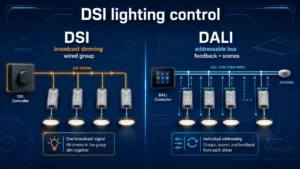
Ask manufacturers for current product information that is relevant to the selected source and driver: photometry, spectral information where required, colour-quality data, dimming behaviour and any flicker or temporal-light-modulation evidence. The control method matters. DALI, Casambi, phase dimming and other approaches rely on different driver, wiring and commissioning arrangements; performance should be considered at the operating levels the building will use, rather than only at full output.
A practical specification also needs to allow for the appearance of finishes and materials in the space. High colour quality may be important in some workplaces, reception areas, education settings or retail-facing environments, but the chosen metric should follow the brief and applicable WELL requirement rather than an assumed universal threshold.
Daylight, electric light and controls need to work together
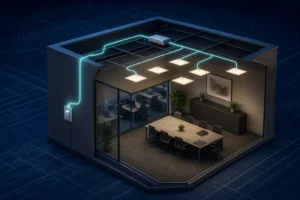
Automated shading and dimming can help a design respond to changing daylight, but only when the sequence is understandable to occupants and maintained after handover. A control narrative should state which luminaires respond to daylight, where sensors are positioned, how local override operates, what happens after a manual adjustment and how the system returns to its normal state.
Controls should also respect different patterns of use. An open-plan office, meeting room, circulation area and reception may have different hours, screen use and daylight exposure. Presence sensing, daylight response and scene control may each have a place, but they should be selected for the occupied space and the installed control gear. Read more about commercial lighting controls when considering the implications for luminaires, drivers and commissioning.
Documentation is as important as intent. Keep the luminaire schedule, photometric files, spectral data, controls narrative, daylight/shading assumptions and calculation outputs aligned. Late substitutions can change distribution, shielding, output, spectral performance or driver behaviour, so they should be reviewed against the project evidence rather than treated as like-for-like automatically.
A practical WELL lighting checklist
- Confirm the project’s WELL version, current addenda, scorecard and selected Light features.
- Define the occupied areas, work patterns and representative eye-level calculation positions.
- Model daylight and electric-light conditions using the proposed luminaires, optics and source data.
- Coordinate electric glare, solar glare, workstation positions and shading controls.
- Specify colour-quality and temporal-light evidence against the current project requirement.
- Record dimming, sensor, scene and override behaviour in the controls narrative.
- Retain the documentation required for review and on-site verification.
Frequently asked questions
Is WELL a legal lighting requirement in the UK?
WELL is a building rating system, not a replacement for the statutory duties and standards that apply to a UK project. A project team should identify its legal and contractual requirements separately, then decide whether WELL certification or alignment is part of the brief.
Can CCT alone demonstrate circadian-lighting compliance?
No. The current WELL guidance points to the spectral power distribution of the selected source and modelling at the vertical plane at eye level. A nominal CCT describes the appearance of light, but it is not a complete melanopic-performance calculation.
Which WELL requirement numbers should be used?
Use the feature names and requirements in the live standard and the project’s current scorecard. Older articles can retain useful design principles, but historical feature numbers and numerical targets should not be copied into a current specification without verification.