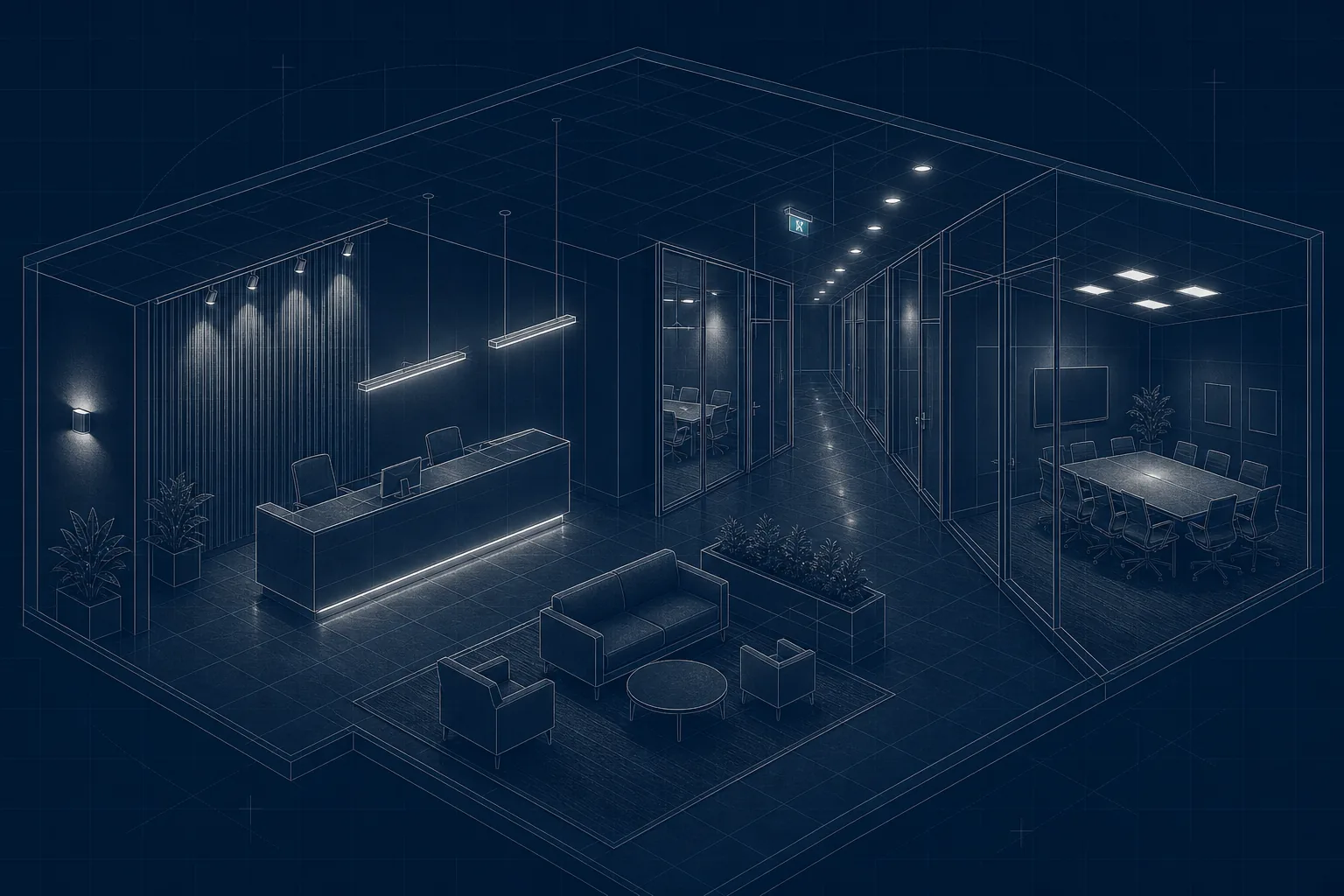
A precise lighting specification defines how a workspace looks, performs, and endures. For specifiers, architects, and facilities professionals, it’s not simply a schedule of parts — it’s the blueprint for visual comfort, energy performance, and design integrity.
This guide explains how to build a robust, circular, and compliant lighting specification under UK standards.
The Challenge of Specification Integrity
Lighting design often becomes the first target of cost-cutting. When a specification is too open (“or equal and approved”), contractors can replace fittings with cheaper equivalents that appear similar on paper but compromise optical control, build quality, or sustainability.
To protect design intent:
Tie performance metrics — UGR, CCT, SDCM, CRI, circularity rating — directly to project intent.
Define equality terms in measurable language, e.g. “equal optical distribution verified within ±5 % of specified luminaire photometrics.”
Require physical samples for approval before alternates are accepted.
A specification with these clauses becomes “sticky”: it can’t easily be value-engineered without genuine technical equivalence.
The UK Regulatory Framework
Modern office lighting must align with several key documents:
BS EN 12464-1: 2021 – Lighting of Indoor Workplaces
Sets illuminance, uniformity, glare control, and colour rendering for task areas.CIBSE Lighting Guides (LG7, LG14, LG17)
Application-specific design guidance for offices, control rooms, and retail spaces.SLL Code for Lighting (2022)
Outlines visual comfort, energy efficiency, and human-centred design principles.Building Regulations Part L (2021)
Requires high-efficacy luminaires and automatic controls such as daylight or presence detection.CIBSE TM66 – Circular Economy Assessment Method
Measures how repairable and recyclable luminaires are — vital for corporate sustainability goals and circular procurement.
Key Specification Criteria for Commercial LED Lighting
1. Lighting Performance
Include measurable parameters for every luminaire:
| Parameter | Typical Office Value | Notes |
|---|---|---|
| Maintained illuminance | 500 lux on task plane | General office work |
| Uniformity | ≥ 0.6 | Even distribution |
| UGR | < 19 | Visual comfort for screens |
| CCT | 4000 K ± 150 K (≤ 3 SDCM) | Neutral white; consistent colour |
| CRI | ≥ 80 (≥ 90 for design zones) | True colour rendering |
| Beam control | As per task | Micro-prismatic or dark-light optics |
For deeper reference, see Understanding Unified Glare Rating (UGR).
2. Energy and Control Strategy
Under Part L, lighting efficacy alone isn’t enough — active controls are mandatory.
Specify:
Control protocol (e.g. DALI-2, phase dimmable, non-dimmable or Casambi wireless control).
Presence and daylight sensors per zone.
Standby power ≤ 0.5 W.
Addressable emergency testing (self-test or DALI).
For full control options, review Energy-Efficient Lighting Control.
3. Reliability and Lifetime
Define realistic service life:
LED modules ≥ L90 @ 50 000 h.
Drivers ≥ 50 000 h @ Ta 40 °C.
Replaceable components and tool-free maintenance.
IP/IK ratings to match location.
Application Guidance by Sector
Offices and Workplaces
Modern offices demand comfort and flexibility. Maintain 500 lux at desk level with uniformity ≥ 0.6 and UGR < 19.
Use task-ambient layering rather than uniform grids. Specify optical systems that reduce glare and enhance visual comfort.
Warehouses and Industrial Areas
Typical targets:
Storage 200–300 lux,
Picking / Inspection 500 lux, uniformity ≥ 0.4.
High-bay fittings like Beam 183 or Radiance 174 suit mounting heights > 10 m.
Add clauses such as: “Drivers shall be replaceable from below the luminaire to permit maintenance at height.”
Try our Warehouse lighting calculator.
Retail and Hospitality
Accent areas need CRI ≥ 90 and ≤ 3 SDCM for colour fidelity. Combine ambient and accent layers to avoid flat illumination.
Include a dimmable protocol in the spec so non-dimmable alternates are rejected.
Education and Healthcare
Classrooms: 300–500 lux, UGR ≤ 19, separate control for presentation surfaces.
Healthcare: CRI ≥ 90, flicker < 5 %, good vertical illuminance.
Reference project photometric files (LDT/IES) to tie the design to the product, locking the specification.
Emergency and Escape Lighting
Integrate emergency design early. Follow BS EN 1838 and BS 5266 for spacing and minimum illuminance (1 lux on escape routes).
State:
3 h duration,
LiFePO₄ battery,
Auto or DALI self-test.
Recommended standalone emergency fittings: Guard Emergency, Beam Emergency, or Bright Emergency Bulkhead.
Full guidance: Emergency Lighting Standards.
Retaining Specification Control
To keep your design intent intact:
Avoid purely performance-based specs for signature areas.
Use selective “or equal” clauses.
Document finishes, reflector types, and materials.
Require mock-ups and sample approval.
These steps maintain control and prevent diluted substitutions.
Selecting Products and Suppliers
A strong specification is backed by evidence:
Certified photometry (IES/LDT).
BIM/Revit models.
Driver and circuit data.
EN 60598 and UKCA compliance.
For full photometry, BIM files and compliance data, see individual Lumenloop product pages.
Controls Integration
Controls should be coordinated at design stage, not left for installation.
Document zoning, interface, and commissioning requirements.
Specify clearly:
“All luminaires must be compatible with the chosen control system (DALI-2 or Casambi). Mixed protocols are not permitted within a single zone.”
This avoids costly re-commissioning later and ensures seamless operation with systems like Casambi.
Implementation, Commissioning & Maintenance
At handover, require:
Pre-installation verification (mounting, wiring, controls).
Measurement of maintained illuminance and emergency duration.
Digital O&M manuals with LDT files, driver data, and schematics.
Defined cleaning and inspection intervals.
Using modular, recyclable luminaires such as those in the 98 % Recyclable Range simplifies long-term maintenance and boosts TM66 scores.
TM66 data and recyclable fittings.
TM66 data and recyclable fittings should not be an afterthought in a commercial lighting specification. If circularity matters to your client — and increasingly it does — then it needs to be written directly into the document.
Embedding Circular Economy Requirements into Your Specification
Most specifications still focus on light output, efficacy and controls. Fewer define what happens in year 10 or year 15.
If you want to futureproof a project, include measurable circular criteria:
Minimum TM66 rating (e.g. “Luminaires shall achieve TM66 ‘Good’ or above.”)
Replaceable LED boards and drivers without destructive disassembly
No permanently bonded optical assemblies
Standardised, widely available drivers (not proprietary sealed units)
End-of-life material declaration
This shifts the discussion from initial capex to long-term asset strategy.
A circular specification is harder to strip down during value engineering because recyclability and serviceability are either present — or they are not.
Writing a Lighting Specification That Survives Value Engineering
A common failure point is over-reliance on performance summaries.
Instead of writing:
“LED panel, 500 lux, UGR < 19, 4000 K.”
Strengthen it:
Define optical type (microprismatic / dark-light louvre).
Define glare angle limits.
Define colour consistency (≤ 3 SDCM initial and maintained).
Define lumen maintenance (L90 @ 50,000 h minimum).
Require photometric verification within ±5% of submitted IES/LDT files.
Specify maximum flicker percentage (< 5%).
These clauses create technical friction against poor substitutions.
You can also include:
“Alternative luminaires must demonstrate identical optical distribution and equivalent circular economy rating.”
This moves the burden of proof away from the designer.
Example: Office Lighting Specification Structure
Below is a simplified structure often used in commercial projects.
1. Design Intent
500 lux maintained on task plane.
UGR < 19 at all viewing angles.
Neutral white 4000 K, ≤ 3 SDCM.
Uniformity ≥ 0.6.
Reference the requirements set out in BS EN 12464-1: Workplace Lighting Standards.
2. Luminaire Performance
Efficacy ≥ 130 lm/W system.
L90 @ 50,000 h.
CRI ≥ 80 (≥ 90 where required).
Replaceable driver and LED module.
3. Controls
DALI-2 or Casambi wireless architecture.
Presence detection per zone.
Daylight harvesting on perimeter zones.
Standby ≤ 0.5 W.
For practical control strategies, align with Using Lighting Controls to Meet Part L Building Regulations Requirements
4. Emergency Integration
3-hour duration.
Self-test or addressable test via DALI.
Spacing verified to meet 1 lux minimum along escape routes.
5. Documentation and Handover
IES/LDT files submitted pre-install.
Commissioning report.
Lux level verification.
O&M manual including driver replacement instructions.
Sector-Specific Considerations That Strengthen Your Spec
High-Bay Industrial
Where mounting heights exceed 8–10 metres:
Define lumen packages based on mounting height.
Require drivers replaceable from below.
State IP65 minimum for dusty environments.
High-output luminaires such as Beam 183 or Radiance 174 are typically selected in these conditions due to optical control and maintainability.
Emergency-Heavy Environments
In stair cores, plant rooms and circulation spaces:
Define IK ratings (e.g. IK08+).
Require LiFePO₄ batteries.
Specify temperature tolerance.
Standalone fittings such as Guard Emergency or Bright Emergency Bulkhead are commonly used where independent emergency resilience is required.
Common Specification Mistakes
Even experienced designers fall into predictable traps.
Confusing L70 with maintained illuminance
L70 does not guarantee maintained lux compliance at year 10.Ignoring colour consistency
Large projects with >200 fittings can look visibly patchy without ≤ 3 SDCM control.Leaving controls undefined
“Dimmable” is not a control strategy.Omitting serviceability clauses
Sealed units may look clean on paper but become landfill when a driver fails.Not verifying emergency spacing
Photometric spacing tables must match ceiling height and corridor width.
Each of these oversights can undermine a well-intentioned design.
A Practical Lighting Specification Checklist
Before issuing your document, confirm:
All performance metrics are measurable.
Equality terms are technically defined.
Control protocol is fixed.
Emergency duration and battery chemistry are stated.
Circular economy requirement is documented.
Photometric files are referenced.
Maintenance access is considered.
Finishes and materials are specified.
If a contractor can substitute a fitting without proving equivalence in each of these areas, the specification is not robust enough.
Final Thoughts
A commercial lighting specification is not just a parts list. It is a technical safeguard that protects visual comfort, compliance, operational efficiency and long-term asset value.
When performance metrics, regulatory alignment, control strategy and circular economy principles are written clearly and measurably, the specification becomes difficult to dilute.
That is ultimately the goal — not to prevent value engineering, but to ensure that any change maintains the same technical integrity.
If written properly, your lighting specification becomes a long-term performance document rather than a short-term purchasing schedule.