
Lighting Designed for Circularity: TM65 & TM66 in Practice
TM65 & TM66 Assessed Luminaires
Real, assessed luminaires only. One series is visible by default; switch between families to compare TM66 circularity and TM65 material composition.
—
Rating: —TM66 Circularity (CEAM pillars)
Design for Disassembly · Material Efficiency · Sustainable Manufacturing · End-of-Life Strategy
TM65 Material Composition
% by mass (Aluminium / Electronics / Plastics / Other). “Other” auto-calculates to reach 100%.
| Material | % by mass |
|---|
Compare with another series
—
—
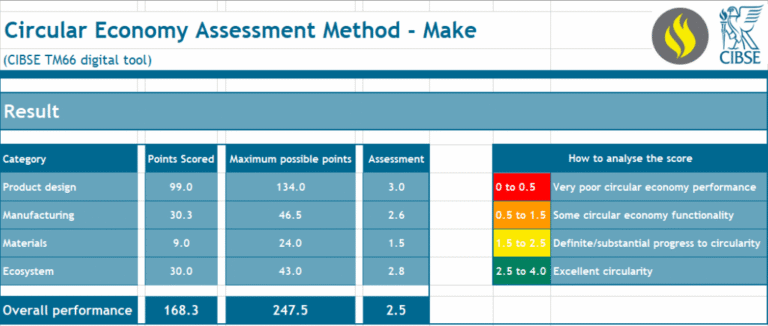
The results from CIBSE’s CEAM digital tool shows the Eco 78 scoring ‘excellent circularity’
TM65 and TM66: what each assessment tells you
TM65 and TM66 answer two different questions about a luminaire. TM65 estimates embodied carbon: the greenhouse gas emissions associated with a product across defined life-cycle stages. TM66 assesses circularity: how well the product supports longer use, repair, disassembly, reuse and material recovery.
Used together, they give a project team a more useful view than either assessment alone. A luminaire can have a strong circularity assessment without proving low embodied carbon, while an embodied-carbon figure does not by itself show whether a fitting can be repaired or kept in service.
TM65: estimating embodied carbon
CIBSE TM65 provides a methodology for estimating the embodied carbon of building-services equipment when a suitable product-specific environmental product declaration (EPD) is not available. For lighting equipment, TM65.2 adds guidance specific to luminaires.
The calculation uses available product data and stated assumptions to estimate emissions across relevant life-cycle modules. It is intended to help designers compare options and account for building-services equipment more consistently. It is not an EPD, and a manufacturer-prepared TM65 calculation should not be presented as independently verified unless it has gone through a recognised verification process.
TM66: assessing circularity
CIBSE TM66 focuses on the practical characteristics that help move lighting away from a take-make-dispose model. Its Circular Economy Assessment Method (CEAM) considers evidence such as product design, manufacturing, materials and the services offered around the luminaire.
For a specifier, the value is in the evidence behind the result: whether components can be accessed and replaced, whether the fitting can be disassembled, whether spares and technical information are available, and what happens to the product at the end of its first service life.
| Assessment | Primary purpose | Evidence to request | What it does not prove |
|---|---|---|---|
| TM65 / TM65.2 | Estimate embodied carbon for a defined product and life-cycle scope | Product configuration, calculation boundary, data sources, assumptions, life-cycle modules and kgCO2e result | Repairability, circularity or independently verified EPD status |
| TM66 / CEAM | Assess how a lighting product and its supporting services enable a circular economy | Assessment version, score, product-specific answers and supporting documentation | A low embodied-carbon result or whole-life operational energy performance |
What to request from a lighting manufacturer
A headline score is useful for screening, but it is not enough for a robust specification. Ask for an evidence pack that relates to the exact luminaire and configuration being proposed.
- Product identity: the precise model, output, driver, controls, emergency option and other components covered.
- TM65 basis: whether the figure comes from an EPD or a TM65/TM65.2 calculation, including its boundary, modules, data sources and assumptions.
- Carbon result: the stated kgCO2e value and enough context to compare it with an equivalent product on the same basis.
- TM66 evidence: the CEAM version, assessment result and the supporting answers or documents rather than a score in isolation.
- Service-life support: information on replaceable components, access and disassembly, spare-part availability, repair instructions, warranties and take-back routes.
- Assessment status: who prepared or verified the evidence and when it was completed.
How to use TM65 and TM66 in a lighting specification
- Meet the lighting brief first. Shortlist fittings that satisfy the project’s photometric, control, emergency, environmental and service-life requirements.
- Compare like with like. Check that embodied-carbon figures cover equivalent product configurations and life-cycle modules. Do not compare a bare luminaire with a version that includes emergency gear or controls.
- Review the circularity evidence. Look beyond the CEAM result to understand how the product can be maintained, upgraded, repaired and recovered in practice.
- Record the evidence. Retain the calculation, assessment version, product schedule and supporting documents with the project information so the decision remains traceable.
These assessments also work best alongside the operational design. An efficient, controllable lighting scheme can reduce energy use in service; TM65 and TM66 add evidence about the product’s embodied impact and its potential to remain useful for longer.
Evidence for Lumenloop luminaires
Lumenloop can provide product-specific sustainability information for selected luminaire ranges. Because values depend on the model and configuration, the appropriate evidence should be checked against the exact fitting in the project schedule rather than treated as a blanket claim across every product.
Use the TM66 circularity calculator to explore the assessment approach, or contact our lighting team to request the available TM65, TM66 and supporting product information for a specification.
TM65 and TM66 frequently asked questions
Is a TM65 calculation the same as an EPD?
No. An EPD is produced to defined standards and includes independent verification. TM65 provides a practical methodology for estimating embodied carbon when suitable EPD data is unavailable. Any verification status should be stated clearly.
Does a strong TM66 result mean a luminaire has low embodied carbon?
No. TM66 assesses circular-economy performance, while TM65 estimates embodied carbon. The two are related to sustainable product selection but measure different things.
Should TM65 and TM66 be used together?
Yes, where the information is available. TM65 helps quantify embodied impact, while TM66 helps test whether the product is designed and supported for a longer, more circular life. Both should sit alongside the technical lighting design and operational-energy strategy.
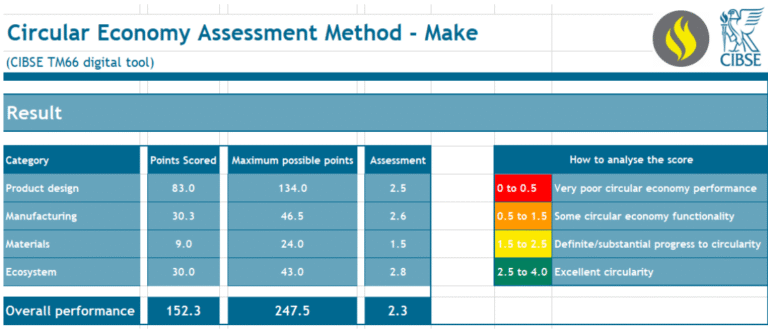
Natura 125’s TM66 scorecard (LED panel)
