CIE S 026: How the New Standard Is Changing Lighting Measurement

CIE S 026
Discover how CIE S 026 is revolutionising lighting measurement. Learn about the new standard's impact on the industry and its practical applications

What if your lighting scheme meets every lux requirement—and still leaves occupants tired, unfocused, or sleeping badly?

That’s the gap CIE S 026 closes. It doesn’t replace traditional lighting design. It exposes where it’s incomplete.

The shift is simple: you’re no longer just designing for vision. You’re designing for biology—and now you can measure it properly.

Why lux alone isn’t enough anymore

Lux tells you how bright a surface appears to the visual system. It says nothing about how that light affects alertness, sleep, or circadian timing.

Two fittings can both deliver 500 lux on a desk:

  • One supports alertness
  • One does very little biologically
  • The difference is spectral content.

The introduction of the CIE S 026 framework marks a fundamental shift. It moves beyond traditional visual metrics to address light’s profound impact on our biology.

The Shift: From “Can You See?” to “How Does This Affect People?”

Traditional lighting design is built around visual performance:

  • Lux targets (BS EN 12464-1)
  • Glare limits (UGR <19 in offices)
  • Uniformity ratios
  • Energy compliance

CIE S 026 introduces a second dimension: biological response.

This is based on how light stimulates five photoreceptors in the eye—not just cones for vision, but also melanopsin-driven responses linked to circadian rhythm.

https://images.openai.com/static-rsc-4/bAldXpfqqXowwjx8yGAIscW_WQVQQQsegJsyXpc8Oj6CYoHPAadQjOdNQJ_uq_0lZRC9d8zT9EmZIy3iROJJwVYnQ81-4boYW5jBtlcf9qwsB8ydJp3-FaAvcfNpTC8R9EBmlsNqNub06kuyu8I9ZR20Cqa3aSVf2lTHy3Y0OH7h7zZyOzugsawm_RighCsx?purpose=fullsize


What this means in practice

You can now quantify:

  • How “alerting” a space is during the day
  • Whether evening lighting will suppress melatonin
  • How spectral distribution—not just output—affects occupants

This is the key shift: lux alone no longer predicts experience

Where This Actually Changes Specifications

This isn’t theoretical. It directly affects how you design real spaces.

Offices

Typical target:

  • 300–500 lux on task plane
  • UGR <19

With CIE S 026, you should also consider:

  • Melanopic EDI (Equivalent Daylight Illuminance)
  • Morning exposure levels to support alertness

Practical approach:

  • Use higher melanopic output in the first half of the day
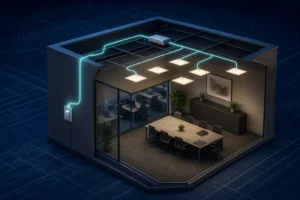
  • Combine with DALI or Casambi controls for time-based tuning
  • Avoid over-reliance on static 4000K if spectrum isn’t optimised

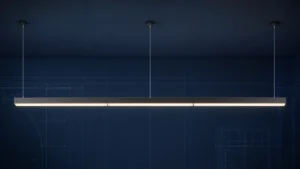
Linear systems like Optima 87 or Optima 87 Suspended allow consistent distribution and control integration across open-plan layouts.

A vibrant and intricate illustration depicting the scientific concept of non-visual photoreception. In the foreground, a highly detailed cross-section of the human eye, showcasing the specialized photoreceptor cells responsible for detecting light beyond the visible spectrum. The middle ground features a stylized diagram of the brain's visual and non-visual processing pathways, with intricate neural connections and glowing centers of activity. In the background, a radiant, abstract landscape of overlapping light waves and electromagnetic fields, conveying the broad spectrum of light energy that influences human physiology and behavior, beyond the limitations of conscious sight.

Healthcare

Here, the impact is more critical.

You’re not just lighting for visibility—you’re influencing:

  • Recovery cycles
  • Sleep quality
  • Staff fatigue

Design implications:

  • Daytime: higher melanopic stimulus (blue-enriched spectrum)
  • Night: reduced melanopic content, even if lux remains adequate

This often leads to:

  • Tunable white systems
  • Zoned control (patient vs staff areas)
  • Careful vertical illuminance planning (not just horizontal lux)

Education

Students don’t benefit from flat lighting.

CIE S 026 supports:

  • Higher alertness in morning sessions
  • Reduced stimulation in late afternoon

What actually works:

  • 300–500 lux maintained
  • Increased vertical illuminance at eye level
  • Spectral tuning across the day

Without this, you get compliant lighting that still feels dull and fatiguing.

Why Lux Is No Longer Enough

Two schemes can both hit 500 lux—and behave completely differently.

That’s because lux is based on photopic sensitivity (V(λ)), which peaks at 555nm.

Melanopic response peaks closer to 490nm.

 
https://images.openai.com/static-rsc-4/laJ6zRY7ER0k89pz08iLBqZctYnKwcHlhoiosHM43qeVsC5XMcb5_965lgtzLcVkPD2n0G12qcARdEJT7z9CWIQenSuibTdOpywijHUH2mjAv2_SB9bhcn_Sb4w_GSW_uAhW2HttJjcAXmJgdFbuVwn2pGjFYe0yJhFkH3GMMEXQEbV7oECkKOEXQ8emeBbF?purpose=fullsize
https://images.openai.com/static-rsc-4/jU6rH06IpwUUBwdV5VzrCggwIKY0GO91OpTkbjbDa1Vm3oiSBIrhYlBNS-5nYuMg7zywpqlomPICxsg_RZCMxnnl8ubm6PDdfms6DXmqylXNiyi6lmbljSsJvq_bYRbYvAOnp70K1_P5suN1eSQZuFlKgU57bFDO3FG5ubTY4DLPl61DLCaISt0GalnpkMT5?purpose=fullsize
 

Practical consequence

  • A cool white LED may deliver higher biological stimulus per lumen
  • A warm white scheme may feel comfortable but reduce daytime alertness

So the decision isn’t just:

“What lux level do we need?”

It becomes:

“What spectral output supports the way this space is used?”


How to Apply This Without Overcomplicating Projects

You don’t need to turn every job into a research project.

But you do need to stop ignoring spectrum.

A workable approach

Space TypeLux TargetMelanopic StrategyControls
Office (day)300–500Moderate–high melanopicTime-based dimming
Office (evening)300Reduced melanopicScene control
Healthcare100–500Dynamic (day/night contrast)Tunable white + zoning
Education300–500Elevated morning stimulusScheduled scenes

Key design considerations

  • Vertical illuminance matters
    Eye-level light drives circadian response more than desk lux
  • Distribution matters
    Wide beam, uniform systems outperform point sources
  • Controls are essential
    Static lighting cannot support changing biological needs

Common Mistakes to Avoid

1. Assuming CCT = biological effect

4000K doesn’t guarantee high melanopic output. Spectrum matters.

2. Over-lighting to compensate

Increasing lux is inefficient and often unnecessary.

3. Ignoring glare while chasing biology

UGR still matters. A biologically “correct” space with poor visual comfort will fail.

4. Treating this as optional

Clients may not ask for it yet—but they will feel the difference.

What This Means for Product Selection

You don’t need specialist luminaires for every project.

But you do need luminaires that:

  • Provide consistent optical distribution
  • Support control integration (DALI, Casambi)
  • Offer stable spectral performance

For example:

  • Continuous linear systems like Luma 80 or Prisma 82 work well in spaces where vertical and horizontal uniformity both matter
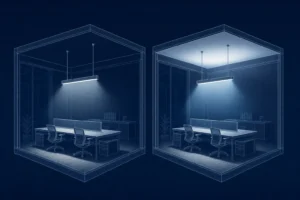
  • Suspended direct/indirect fittings help increase vertical illuminance without excessive lux

The goal isn’t complexity—it’s predictability.

The Real Takeaway

CIE S 026 doesn’t replace what you already do.

It exposes what you’ve been missing.

You can still design to:

  • 500 lux
  • UGR <19
  • Compliance targets

But now you can also decide:

  • Will this space support alertness?
  • Will it interfere with sleep patterns?
  • Will people feel better working here?
 

That’s the difference between a compliant scheme and a considered one.

And increasingly, that’s what clients expect—even if they don’t yet know how to ask for it.

FAQ: Applying CIE S 026 in Real Projects

Do I need to replace lux targets with melanopic metrics?

No. Lux remains essential for compliance and visual performance under BS EN 12464-1.

CIE S 026 adds a second layer. You still design to 300–500 lux in most commercial spaces, but now you also consider whether that light supports alertness or rest.

The practical shift is this:

  • Lux = can people see properly?
  • Melanopic metrics = how does the space affect them?

Both need to be addressed.


What is melanopic EDI and when should I care about it?

Melanopic Equivalent Daylight Illuminance (EDI) is the most practical output from the CIE S 026 framework.

It tells you how effective a light source is at stimulating circadian response, expressed in a daylight-equivalent value.

You should care about it when:

  • Designing offices where productivity matters
  • Healthcare environments where sleep cycles are critical
  • Education settings where alertness fluctuates

If the space is occupied for long periods, melanopic EDI becomes relevant.


Can I achieve this with standard LED luminaires?

Yes—if you select them properly.

You don’t necessarily need specialist “circadian” fittings. What matters is:

  • Spectral distribution (not just CCT)
  • Good optical control and distribution
  • Compatibility with control systems

For example, continuous linear systems like Optima 87 provide consistent output and integrate easily with DALI-based control strategies.

The limitation is rarely the luminaire—it’s how it’s applied.


Is tunable white always required?

No. It depends on how dynamic the space needs to be.

  • Static offices: A well-chosen fixed spectrum can be sufficient
  • Healthcare or shift work: Tunable white becomes far more valuable
  • Education: Somewhere in between

If the lighting needs to change meaningfully throughout the day, tunable white is worth considering. Otherwise, focus on getting the baseline spectrum right.


How important is vertical illuminance?

It’s critical—and often overlooked.

Circadian response is driven by light reaching the eye, not just the desk.

That means:

  • Suspended direct/indirect lighting can outperform downlights
  • Wall washing and ambient brightness improve biological impact
  • A perfectly compliant 500 lux desk can still feel “flat” if vertical light is poor

In practice, improving vertical illuminance often has more impact than increasing lux.


Will this increase energy consumption?

Not necessarily.

In many cases, the opposite is true.

Instead of increasing lux levels to make spaces feel brighter or more alert, you:

  • Use spectrum more effectively
  • Apply light where it matters (eye level)
  • Introduce controls to reduce output when not needed

The result is often better performance at the same or lower energy use.


Does CCT (e.g. 3000K vs 4000K) define biological effect?

No—and this is a common mistake.

CCT is a rough visual indicator, not a biological metric.

Two 4000K luminaires can have very different melanopic outputs depending on their spectral distribution.

If you’re making decisions based on CCT alone, you’re guessing.


When should I start applying CIE S 026 on projects?

Now—selectively.

You don’t need to apply it to every project in full detail, but you should start considering it when:

  • Spaces are occupied for long durations
  • Occupant wellbeing is a priority
  • You’re already using controls or higher-spec lighting systems

At a minimum, it should influence how you think about spectrum and distribution—even if you’re not formally calculating α-opic values yet.


Is this becoming a requirement or still optional?

Right now, it’s not mandatory in most specifications.

But it is increasingly expected.

Clients may not reference CIE S 026 directly, but they will ask for:

  • “Human-centric lighting”
  • Better workplace wellbeing
  • Improved occupant comfort

This standard is the framework behind those requests.

Ignoring it doesn’t break compliance—but it does limit the quality of the outcome.

Share:

More Posts

flexible track lighting

Track Lighting Layout Ideas for Retail and Commercial Spaces

Track lighting gives you flexibility, but only if it’s designed properly. This guide breaks down how to plan track lighting layouts for retail and commercial spaces, including beam angles, spacing, positioning, glare control, and how to create schemes that actually work in practice.

Send Us A Message

View Products

Recent Blogs

lumenloop svg white tp
recolight badge
Stay in the Loop

Let's Talk