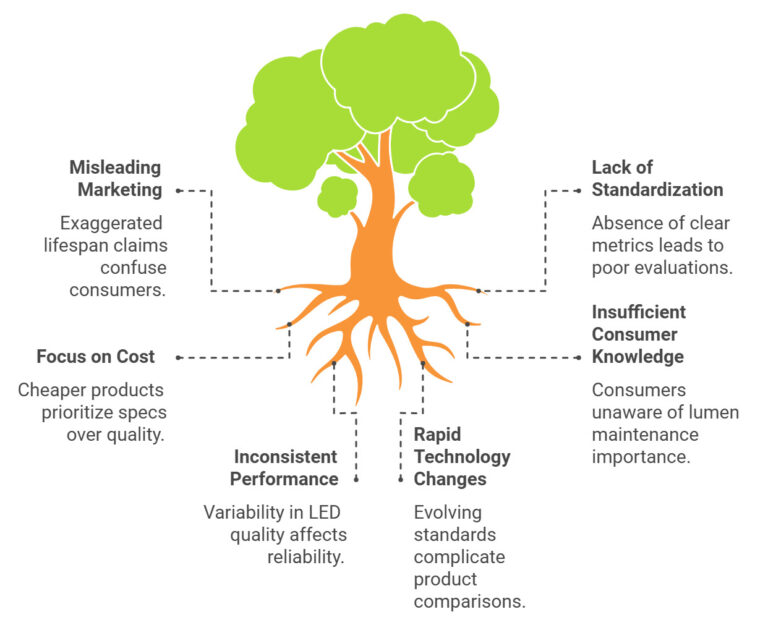
One of the biggest misconceptions in LED lighting is that lifespan is a simple number. You’ll often see claims of 50,000, 100,000, or even longer operating hours used as shorthand for quality. In reality, LED performance is far more nuanced.
Industry testing has repeatedly shown that a significant proportion of LED products do not perform in line with their headline claims once installed. This is rarely because LEDs “burn out” like older technologies, but because light output, colour quality, or electronics degrade long before the quoted lifespan is reached.
That’s where lumen maintenance and L70 ratings matter. They tell a much more honest story about how an LED fitting will actually perform over time.
Lumen maintenance visualiser
A clear way to explain why “still on” is not the same as “still delivering the right light”.
Budget luminaire
Headline values look great, long-term performance is often less clear.
Lifetime claim (often not tied to maintained output)
- May be tested under ideal conditions
- Heat and driver quality can dominate real-life outcomes
- Often “still on” while quietly under-lighting a space
Lumenloop luminaire
Performance-led: declared maintenance points and clearer expectations.
- Focus on maintained output, not just “hours”
- Better optical control means fewer wasted lumens
- Easier to plan compliance and maintenance
This is a visual explainer using simplified decay curves. It helps users understand concepts like lumen maintenance and L70 (it is not a substitute for LM-80/TM-21 reporting).
Selected point
Compare maintained output at this point in time.
Budget luminaire output
“Still on” can still mean under-lighting and more complaints.
Lumenloop luminaire output
Declared maintenance points make planning easier.
—
Budget: —%
Lumenloop: —%
Why LED “Lifetime” Figures Can Be Misleading
Traditional light sources such as incandescent or fluorescent lamps tended to fail suddenly. Average rated life made sense because a lamp was either on or off.
LEDs behave differently.
Rather than failing outright, LEDs usually experience a gradual reduction in light output, changes in colour appearance, or issues with associated components such as drivers. A fitting may still power on, but no longer provide the lighting levels needed to meet design intent or compliance.
This is one of the reasons modern lighting standards focus less on simple lifespan figures and more on how light output changes over time, particularly in workplaces designed to meet BS EN 12464-1 workplace lighting standards.
What Is Lumen Maintenance?
Lumen maintenance describes how much of an LED’s original light output remains after a given period of operation.
It is expressed as a percentage of the initial lumens, measured under defined test conditions. For example:
• 90% lumen maintenance at 50,000 hours
• 80% lumen maintenance at 75,000 hours
Because LEDs fade gradually rather than failing suddenly, lumen maintenance provides a much clearer picture of how lighting will actually perform in use, particularly in environments where consistent illumination matters.
Understanding L70 Ratings in Practice
The most commonly referenced lumen maintenance metric is L70.
An L70 rating defines the point at which an LED has depreciated to 70% of its original light output. For many commercial applications, this is considered the end of useful life, even though the LED may continue operating beyond this point.
An L70 value always needs to be read alongside the number of hours it relates to. An LED rated at L70 50,000 hours is very different from one rated at L70 100,000 hours, even if both are described as “long life”.
This distinction is particularly important in offices, education and healthcare environments, where falling light levels can affect visual comfort, productivity and compliance. Issues such as glare and visual fatigue are explored further in our guide to unified glare rating and visual comfort.
L/B Values and Why They Matter on Real Projects
Lumen maintenance alone does not tell you how consistently a product performs across an installation.
That’s where L/B values come in. These combine light output retention with an acceptable failure rate across a population of fittings.
For example:
L90B10 at 50,000 hours means:
• At least 90% of original light output is maintained
• No more than 10% of fittings fall below that level
For larger projects, L/B values help predict how uniform lighting will remain over time, rather than assuming every fitting behaves identically. This is particularly relevant in open-plan offices and educational spaces where uneven light loss quickly becomes noticeable.
Why Chasing High Lumens Often Backfires
It’s easy to assume that higher lumen numbers automatically mean better lighting. In practice, perceived brightness does not scale linearly with lumens.
Human vision responds logarithmically to changes in brightness. Doubling lumen output does not look twice as bright, and large increases in lumens often deliver diminishing visual returns while increasing energy use and glare risk.
This is one reason why modern lighting design focuses on distribution, uniformity and visual comfort rather than simply maximising raw output. The relationship between lighting, perception and comfort is explored further in our article on how light affects the way we feel and perform.
Luminous Efficacy vs Luminous Efficiency
Two commonly confused terms in LED specifications are luminous efficacy and luminous efficiency.
Luminous efficacy measures how efficiently electrical power is converted into visible light and is expressed in lumens per watt (lm/W). It is useful for comparing energy performance.
Luminous efficiency, in practical terms, considers how much of that light is actually useful in the space. Optics, glare control, colour quality and thermal behaviour all affect whether the light produced contributes to a comfortable, effective environment.
A luminaire with slightly lower lm/W but better optical control and colour rendering can outperform a higher-efficacy product once installed.
Factors That Affect LED Performance Over Time
Several design and environmental factors directly influence lumen maintenance and lifespan.
Temperature management
LEDs are sensitive to heat. Poor thermal design accelerates lumen depreciation and increases the likelihood of driver failure, one of the most common causes of premature LED issues.
Optical design
Lenses, reflectors and diffusers determine how efficiently light exits the fitting and how evenly it is distributed. Good optical design reduces the need for excessive lumen output.
Colour rendering and colour temperature
Higher CRI values and warmer colour temperatures often reduce efficacy slightly but improve visual comfort and colour accuracy. This trade-off is especially relevant in offices and retail spaces, as discussed in our guide to colour rendering index in LED lighting.
Cheap Specs vs Conservative Data
One pattern seen repeatedly in the market is aggressive specification on lower-cost products.
Very high lumen outputs and optimistic lifetime claims are often based on idealised test conditions rather than realistic operating environments. More conservative specifications tend to come from manufacturers who understand how LEDs behave over time and are prepared to be transparent about long-term performance.
For specifiers and facilities managers, lumen maintenance data, L70 ratings and L/B values are far more useful than headline lumen figures when assessing long-term value.
What This Means for Commercial and Industrial Projects
In commercial environments, small reductions in light output or colour consistency can quickly affect comfort, compliance and productivity. In industrial settings, durability and maintenance cycles may be the priority, but poor lumen maintenance still leads to under-lit spaces and unplanned replacements.
Understanding how light output changes over time allows teams to plan maintenance realistically and avoid surprises later in a building’s life.
This long-term thinking also supports wider sustainability goals, particularly when lighting is viewed as part of a circular approach to design and specification rather than a disposable component.
Conclusion: Measuring What Actually Matters
LED lighting has transformed energy efficiency, but it has also made specification more complex.
Simple lifetime claims no longer reflect how lighting performs in the real world. Metrics such as lumen maintenance, L70 ratings and L/B values provide a far clearer picture of what to expect over time.
By looking beyond headline numbers and focusing on sustained performance, lighting professionals can deliver installations that remain comfortable, compliant and effective for years after installation, not just on day one.
FAQ
What is lumen maintenance in LED lighting?
Lumen maintenance measures how much of an LED’s original light output remains over time. It reflects gradual light loss rather than sudden failure.
What does an L70 rating mean?
An L70 rating indicates the point at which an LED has dropped to 70% of its initial light output, often treated as the end of useful life for many applications.
Why are L/B ratings important?
L/B ratings combine light output retention with acceptable failure rates, helping predict how consistently fittings will perform across an installation.
Are higher lumens always better?
No. Perceived brightness increases more slowly than lumen output, and excessive lumens can lead to glare and wasted energy.
What affects LED lifespan the most?
Thermal management, driver quality, optical design, colour temperature and operating environment all play a major role in LED performance and longevity.