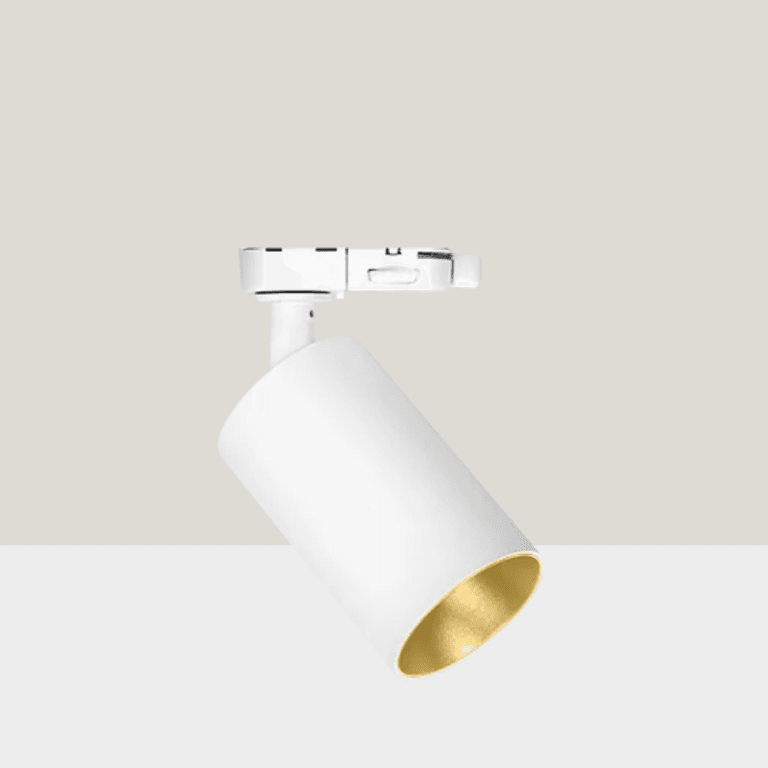
Track lighting is often specified for one reason: flexibility.
But flexibility only works if the layout is planned properly. Poorly positioned track systems lead to glare, uneven lighting, and constant re-aiming on site.
This guide focuses on how to design track lighting layouts that actually work in commercial environments — retail, hospitality, galleries, and flexible workspaces.
Where track lighting works best
Track lighting is most effective where layouts change or focal points shift over time.
Typical applications:
- Retail stores (changing displays, mannequins, shelving)
- Showrooms and exhibition spaces
- Galleries and museums
- Restaurants and bars
- Cat A+ offices and breakout spaces
In more fixed environments, it’s often used alongside linear or panel lighting — for example within broader schemes like commercial LED lighting fixtures for offices.
Start with what you’re lighting, not the track
The biggest mistake is designing around the track layout first.
Instead, define:
- Key focal points (products, artwork, features)
- Viewing distance
- Required contrast
A simple rule of thumb:
| Application | Lighting approach |
|---|---|
| Retail displays | 3:1 contrast vs ambient |
| Artwork | Narrow beam, precise aiming |
| Circulation | Wide beam, uniform light |
| Feature areas | Layered accent + ambient |
Track lighting should support these targets — not dictate them.
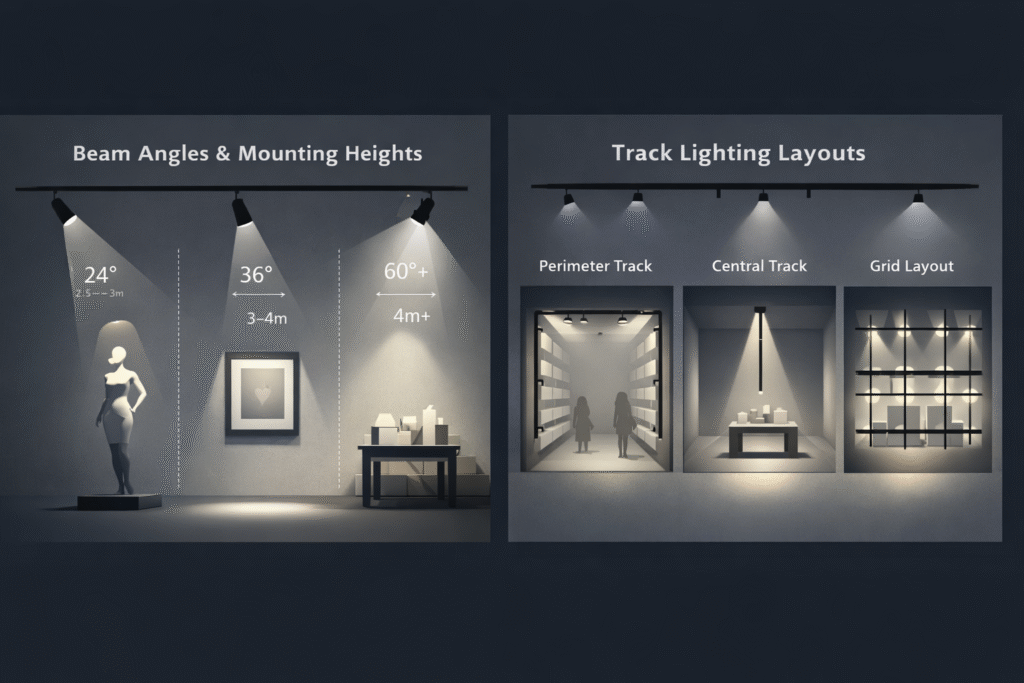
Beam angles: get this right and everything improves
Beam angle selection drives how effective the system is.
| Mounting height | Recommended beam |
|---|---|
| 2.5–3m | 24°–36° |
| 3–4m | 36°–60° |
| 4m+ | 60°+ or higher output |
Key points:
- Narrow beams (15°–24°) for highlighting specific objects
- Medium beams (24°–40°) for general accent lighting
- Wide beams (40°–60°+) for ambient fill
Getting this wrong leads to either:
- Harsh spotlighting
- Flat, low-contrast lighting
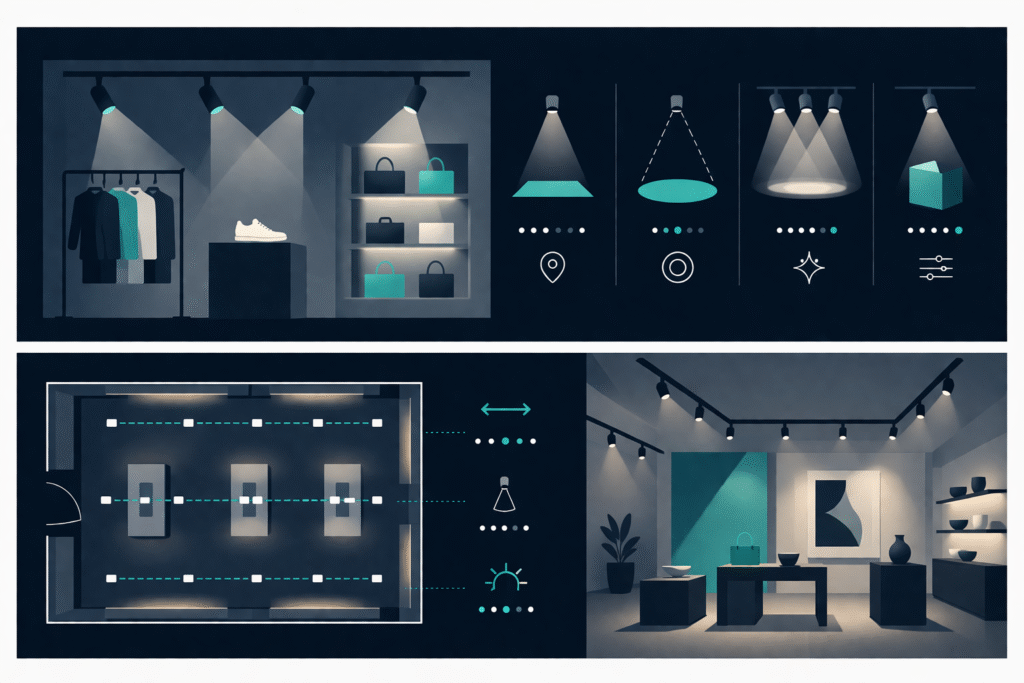
Track positioning: the three layouts that actually work
1. Perimeter track (most common in retail)
Mounted close to walls or displays.
Best for:
- Shelving
- Wall-mounted products
- Artwork
Tip: position track around 0.8–1.2m from the wall to achieve good vertical illumination.
2. Central track (feature-focused)
Installed through the centre of a space.
Best for:
- Feature tables
- Circulation areas
- Statement lighting
Often combined with wider beam fittings.
3. Grid or multi-track layouts (large spaces)
Used in larger retail or open-plan environments.
Best for:
- Flexibility across zones
- Even coverage
- Future layout changes
Spacing between tracks typically ranges from 1.5m to 3m depending on ceiling height and output.
Spacing between fittings on the track
A simple starting point:
- Accent lighting: 1–1.5m spacing
- General lighting: 1.5–2.5m spacing
Then adjust based on:
- Beam angle
- Output (lumens)
- Mounting height
There’s no fixed rule — but consistency matters more than squeezing in more fittings.
Glare control: the difference between premium and poor schemes
Track lighting can quickly become uncomfortable if glare isn’t controlled.
Look for:
- Deep-set light sources
- Anti-glare reflectors
- UGR-conscious design (especially in mixed-use spaces)
If you’re unsure how glare is measured, this guide on understanding unified glare rating UGR breaks it down properly.
Colour temperature and consistency
Track lighting is often used for accent, so colour matters more.
Typical ranges:
- 3000K → retail, hospitality (warmer, more inviting)
- 3500K → neutral commercial environments
- 4000K → task-focused or brighter retail
Consistency across fittings is critical — mixed colour temperatures will immediately stand out (and not in a good way).
Controls: where track lighting becomes powerful
Track systems become far more useful when paired with controls.
Common approaches:
- DALI for zoned control
- Casambi for wireless flexibility
- Scene setting for retail or hospitality
If you’re comparing options, this breakdown of DALI vs Casambi control systems gives a practical view of where each works best.
A quick note on track systems (why Stucchi is widely specified)
Not all track systems are interchangeable.
Track infrastructure matters just as much as the luminaires themselves — especially in commercial projects where reliability and compatibility are critical.
The Stucchi track lighting system is commonly specified because:
- It’s a well-established European standard
- Compatible with a wide range of track spot luminaires
- Available in multiple configurations (surface, recessed, suspended)
- Supports DALI and other control integrations
For specifiers, this reduces risk — fittings can be swapped, upgraded, or repositioned without redesigning the entire system.
Common track lighting mistakes to avoid
Even well-intentioned designs can fall short.
The most common issues:
- Over-lighting with too many fittings
- Ignoring beam angles and relying on “adjustability”
- Poor track positioning relative to displays
- Mixing colour temperatures
- No control strategy
Most of these come down to a lack of planning rather than product choice.
Bringing it together
A well-designed track lighting scheme should feel intentional, not adjustable for the sake of it.
If you get the fundamentals right:
- Beam angles match the space
- Track positions support the layout
- Glare is controlled
- Light is layered properly
You end up with a system that adapts over time without constant rework.
That’s where track lighting delivers real value — not just flexibility, but usable flexibility.