BS EN 12464-1 Lighting Standard Finder
Pick your room type to see typical targets (lux, glare, colour quality). Then sanity-check what you’ve got on site and copy a tidy summary for a spec, email, or snag list.
| Parameter | Typical target | Why it matters |
|---|
What if the most significant factor affecting your team’s safety and productivity was something you literally cannot work in the dark without?
We often overlook the profound impact of proper workplace lighting. Yet, studies reveal a stark reality: poor illumination can slash productivity by up to 20% and cause a 30% rise in accidents.
This is where BS EN 12464-1 comes in. It’s the definitive British standard governing lighting for indoor work environments. Far from being dry red tape, these regulations provide the crucial framework for optimal visual conditions.
The standards cover everything from precise illuminance levels and glare control to colour rendering. They are designed for diverse spaces, from busy offices to complex industrial facilities.
As a lighting manufacturer committed to sustainable, high-performance solutions, we see these standards as the foundation for creating safer, more efficient, and more comfortable workplaces across the UK.
Overview of BS EN 12464-1 Lighting Standards
The journey of workplace lighting standards is a fascinating story of adapting to human needs and global challenges. These regulations have evolved from simple visibility checks into a sophisticated science.

Historical Background and Evolution
Early lighting designs focused purely on basic visibility. The landscape changed dramatically with events like the 1973 oil crisis.
Before the crisis, recommendations sat at 1000 lux for offices. Afterwards, levels dropped to 500 lux with no negative impact on productivity. This showed that more light wasn’t always better.
This experience helped shape modern lighting standards. Today, they balance performance with energy efficiency and visual comfort.
Purpose and Scope in UK Workplaces
The core purpose of these requirements is to protect worker health and enhance comfort. They aim to create productive environments for all types of indoor work.
The scope is comprehensive, covering diverse settings:
- Traditional offices and meeting rooms
- Industrial and manufacturing facilities
- Retail spaces and educational environments
For the lighting industry, these standards represent best practice. They guide us beyond minimum legal requirements towards creating optimal work places.
Benefits of Adhering to Workplace Lighting Standards
Many businesses view lighting standards as a regulatory hurdle. The real value lies in the competitive edge they create. Proper workplace lighting delivers tangible advantages that extend far beyond basic compliance.
Enhanced Employee Wellbeing and Safety
Quality lighting directly impacts how people feel and perform. It reduces eye strain and fatigue that often plague poorly lit spaces. This leads to fewer sick days and better staff retention.
Modern approaches like human centric lighting support natural circadian rhythms. They create a working environment that promotes alertness during daytime hours. This biological alignment enhances overall wellbeing.
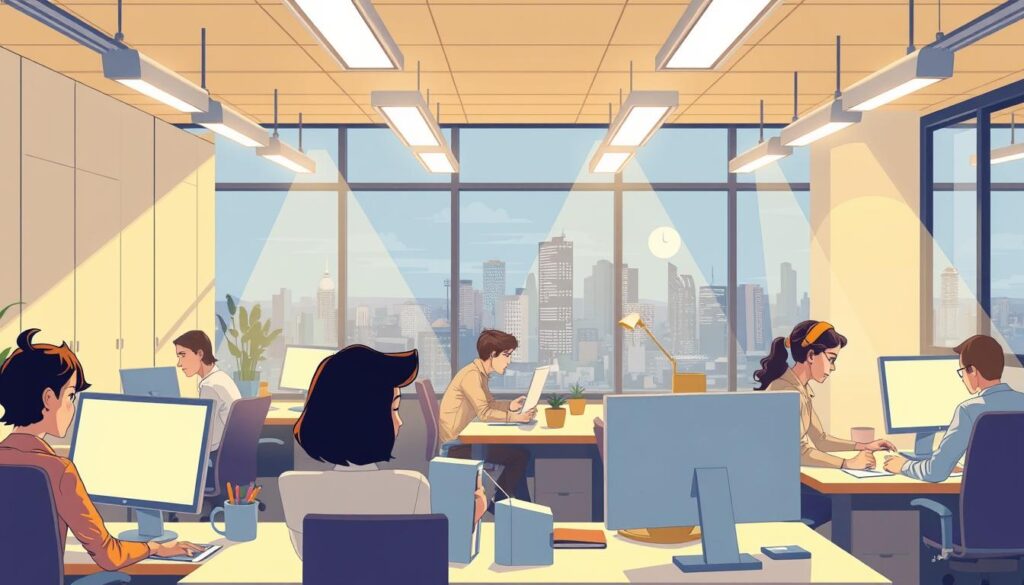
We see significant safety improvements in standards-compliant environments. Proper illumination helps prevent accidents by ensuring clear visibility.
Improved Productivity and Energy Efficiency
Optimised lighting supports cognitive performance and concentration. Research shows task completion rates improve with proper illumination. Error rates drop significantly in well-designed environments.
Modern technology resolves the efficiency challenge. Advanced LED systems and smart controls maintain high lighting levels while cutting energy use. This delivers measurable ROI through lower operational costs.
Investment in quality workplace lighting pays dividends through multiple channels. You gain productivity boosts, accident reduction, and energy savings simultaneously. It’s a comprehensive solution for modern business needs.
Key Technical Components of BS EN 12464-1
At the heart of effective workplace lighting lie three core technical principles that define visual quality and comfort. Getting these elements right transforms a space from merely lit to optimally productive.
We find that understanding these components is essential for specifying luminaires that meet the standards and support your team’s wellbeing.
Illuminance Levels and Measurement in Lux
Illuminance measures the amount of light hitting a surface, expressed in lux. Different tasks need different illuminance levels.
A detailed drawing board requires a high level of light, while a corridor needs less. The standard specifies the right levels for each area and task.
Understanding Unified Glare Rating (UGR)
The Unified Glare Rating quantifies visual discomfort. A lower UGR value means less glare.
Most offices aim for a UGR below 19. Controlling glare is vital for concentration and prevents eye strain over long periods.
Colour Rendering and Visual Comfort
The Colour Rendering Index (CRI or Ra) shows how accurately a light source shows colours. A high rendering index, like Ra 80+, is crucial for tasks needing true colour perception.
Good colour rendering reduces effort and errors, making the environment more comfortable.
Comparing the Key Lighting Components
| Component | What It Measures | Ideal Range for Offices | Primary Impact |
|---|---|---|---|
| Illuminance (Lux) | Amount of light on a surface | 300 – 750 lux (task-dependent) | Visual clarity for specific tasks |
| Unified Glare Rating (UGR) | Level of visual discomfort from brightness | 16 – 19 | Long-term comfort and concentration |
| Colour Rendering Index (CRI/Ra) | Accuracy of colour appearance | 80 – 90 Ra | Accuracy and reduced visual fatigue |
These three requirements work together. The right balance ensures a workspace that is safe, comfortable, and efficient, fully meeting the lighting standards.
Technical Insights: Illuminance and Glare Control
The practical application of lighting standards comes down to two critical factors: delivering the right amount of light where it’s needed most. We focus on translating technical specifications into comfortable, productive environments.
Optimising Task and Surrounding Area Lighting
Different workplace areas require specific illuminance levels measured in lux. Office workstations typically need 500 lux, while detailed technical work may require 1000-1500 lux.
The standard distinguishes between task illuminance, immediate surrounding areas, and peripheral spaces. This zoning approach prevents uncomfortable contrast and supports visual comfort.
Recommended Illuminance Levels for Different Work Areas
| Work Area | Task Type | Required Illuminance (Lux) |
|---|---|---|
| Office Workstation | General computer work | 500 lux |
| Meeting Room | Discussion and presentations | 300-500 lux |
| Industrial Workshop | Machine operation | 750 lux |
| Technical Bench | Detailed assembly work | 1000-1500 lux |
| Retail Space | Product display and sales | 750-1000 lux |
Strategies for Effective Glare Management
Controlling glare is essential for long-term visual comfort. The unified glare rating (UGR) quantifies this discomfort, with lower values being better.
Most offices aim for a UGR below 19. Industrial facilities can tolerate slightly higher ugr value around 19-22. Proper luminaire positioning and optical design help achieve these targets.
We recommend measuring illuminance level across work areas using grid measurements. This ensures compliance while maintaining comfortable lighting conditions.
Best Practices for Lighting Design in Indoor Workplaces
Great lighting design transforms a workplace from merely functional to genuinely inspiring. We focus on strategies that exceed basic compliance to create lighting solutions supporting both wellbeing and efficiency.
This involves a holistic approach balancing natural light, smart technology, and tailored solutions for each unique environment.
Integrating Natural and Artificial Lighting
Effective interior lighting harmonises daylight with electric sources. The standard provides guidance for calculating illuminance levels that account for both.
We use daylight harvesting techniques. This means artificial lighting automatically dims when sufficient natural light is available.
This approach maintains consistent lighting levels for critical task areas. It also delivers significant energy savings.
Smart Lighting Controls and Sustainable Solutions
Modern lighting solutions are intelligent. Occupancy sensors and time-based dimming adapt to how spaces are used.
This ensures light is provided only when and where needed. It directly tackles the challenge of meeting higher lighting requirements while reducing consumption.
We champion a circular economy. Our refurbishable luminaires support sustainability without compromising on a high rendering index or performance.
Design Strategies for Different Work Environments
Each space demands a specific strategy. A one-size-fits-all approach fails to address unique visual task demands.
The right luminaires and optical design are crucial for success in different area types.
Tailored Lighting Design Approaches
| Work Environment | Primary Design Focus | Recommended Luminaire Features |
|---|---|---|
| Office Lighting / Open-plan Offices | Uniform, glare-free illumination for screen work | Low UGR |
| Industrial Spaces | Robust, high-intensity light for demanding tasks | High-bay luminaires, high IP rating, high illuminance levels |
| Educational Facilities | Comfortable, uniform distribution for concentration | Wide beam angles, consistent light levels, minimal glare |
| Healthcare Settings | Precise, adaptable conditions for clinical tasks | High CRI (>90), flexible controls, colour temperature tuning |
Challenges and Considerations in Adapting to BS EN 12464-1:2021
The latest lighting standard update presents a complex puzzle for facility managers across the UK. The 2021 revision significantly raises the bar for workplace illumination, creating both opportunities and practical hurdles that demand careful navigation.
Balancing Increased Lux Requirements and Energy Consumption
The new standard recommends starting at 500 lux for general tasks, potentially rising to 1000 lux based on factors like occupant age. This creates tension between health benefits and sustainability goals.
We see the risk of simplified interpretations where contractors might apply blanket 1000 lux across entire areas. Alternatively, they might under-light peripheral spaces to save costs. Both approaches miss the standard’s nuanced intent.
Modern LED technology and smart controls offer solutions. They deliver higher illuminance levels without proportional energy increases through efficient optics and intelligent management systems.
Addressing Practical Implementation Challenges
Proper implementation requires moving beyond single lux figures. The standard emphasises differentiated lighting for task, surrounding, and peripheral areas.
We believe professional lighting design is essential for navigating these challenges. It ensures increased requirements enhance both sustainability and workplace quality rather than compromising either goal.
The lighting industry must focus on educated specification. This prevents the standard from becoming counterproductive for both energy management and healthful aims in commercial buildings.
Choosing the Right Luminaires for Office and Industrial Spaces
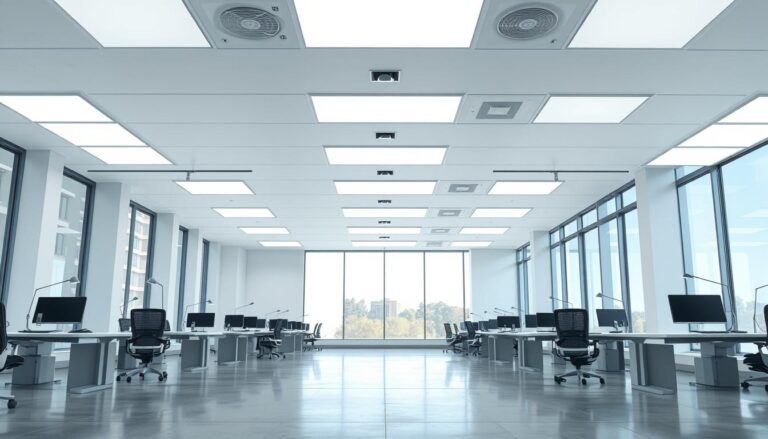
Selecting appropriate luminaires depends entirely on the specific task and area requirements. Open-plan offices typically need suspended direct/indirect fixtures providing 500 lux.
Industrial spaces demand robust high bay LED solutions delivering 750 lux or more. Precision work areas require task-specific luminaires achieving 1500 lux for detailed visual work.
Ensuring Compliance Through Regular Assessments
Maintaining compliance requires systematic assessment using proper measurement techniques. Digital lux meters and uniform grid testing verify illuminance levels across all work areas.
We recommend monthly visual inspections, quarterly illuminance measurements, and annual comprehensive audits. Proper documentation includes survey reports and performance verification records.
Conclusion
The conversation around workplace illumination has shifted from basic compliance to strategic advantage. We see BS EN 12464-1 not as restrictive red tape but as a blueprint for creating environments where people and businesses thrive together.
Proper lighting design delivers measurable benefits—enhanced wellbeing, productivity gains, and energy savings through efficient technology. These standards provide the framework, but thoughtful implementation brings the results.
As a manufacturer, we’re committed to developing luminaires that exceed these requirements while supporting sustainability. The 2021 updates should serve as a catalyst for re-evaluating your current workplace lighting installations.
Looking ahead, evolving technology and deeper understanding of light’s impact on human biology will continue shaping lighting standards. Professional expertise remains essential for navigating this complexity and achieving optimal results.
FAQ
What is the primary purpose of BS EN 12464-1?
The standard’s main goal is to ensure optimal visual conditions for safety, comfort, and performance in indoor work areas. It provides specific guidance on illuminance levels, glare control, and colour rendering to create effective working environments.
How are illuminance levels measured and why are they important?
Illuminance is measured in lux, indicating the amount of light falling on a surface. Adequate task illuminance is crucial for reducing eye strain and enabling workers to perform visual tasks accurately and efficiently, directly impacting productivity.
What is Unified Glare Rating (UGR) and how does it affect a workspace?
UGR is a measure of discomfort glare from luminaires. A lower UGR value means less glare, which is essential for visual comfort. Managing the unified glare rating helps prevent headaches and fatigue, contributing to a healthier workplace.
Can you explain the role of the Colour Rendering Index (CRI) in lighting design?
The colour rendering index measures a light source’s ability to reveal colours accurately compared to natural light. A high CRI is vital in environments where colour discrimination is part of the task, such as in design studios or quality inspection areas.
What are the key differences between the 2011 and 2021 versions of the standard?
The 2021 update introduced more detailed requirements for specific tasks and areas, often recommending higher illuminance levels for modern work like screen-based tasks. It also provides clearer guidance on lighting for ancillary spaces and emphasises visual comfort further.
How can we balance higher lux level requirements with energy efficiency?
Using high-efficiency LED luminaires with smart lighting controls, such as presence detection and daylight harvesting, is the most effective strategy. This approach delivers the required task illuminance while minimising energy consumption by using light only when and where it is needed.
What type of lighting is best for an open-plan office to meet these standards?
A combination of direct/indirect LED luminaires with a low UGR value is ideal. This provides uniform ambient lighting on work surfaces while controlling glare. Supplementing with task lighting allows individuals to adjust their immediate work area illuminance for specific needs.
How often should a workplace lighting assessment be conducted?
We recommend a formal assessment during any significant office refurbishment or change of use. An annual visual check is good practice to identify failed lamps or deteriorating conditions, ensuring ongoing compliance with lighting requirements.