For commercial buildings, e-waste is not only a recycling issue. It is often created much earlier, when a refurbishment brief defaults to full replacement without checking whether existing fittings can be upgraded, reused or replaced more selectively.
For lighting projects, the better way forward is to assess the existing installation first, then work with a UK commercial LED lighting manufacturer to decide whether the scheme needs a renew and reuse review, a wider commercial lighting upgrade, or a new product schedule using longer-life, serviceable luminaires.
That matters because luminaires are not disposable decoration. They contain aluminium, drivers, LED boards, optics, wiring and control gear. Choosing fittings with service access, replaceable components and clear circularity evidence can reduce unnecessary strip-out while still improving energy performance, compliance and visual comfort.
E‑Waste Recycling Dashboard
Interactive guide to understanding and managing lighting e‑waste
Global E‑Waste Statistics
Top E‑Waste Producing Countries (kilotonnes)
Why Lighting E‑Waste Deserves Special Attention
Smart & LED Street Lighting
Fluorescent & CFL Bulb Hazards
How to Recycle Lighting E‑Waste
- Catalogue all lighting assets: bulbs, tubes, fixtures, control gear
- Separate by technology: LEDs, fluorescent, HID, CFL
- Log quantities and anticipated replacement dates
- Use a spreadsheet or CMMS to track lights nearing end‑of‑life
- Look for Environment Agency or SEPA licensed collectors
- Confirm they offer lamp crushing, phosphor recovery and electronics recycling
- Check for proper certifications and compliance history
- Securely package tubes in crush‑resistant boxes or lamp shredders
- Schedule on‑site pickup or drop‑off at designated WEEE facilities
- Ensure proper handling to prevent breakage of hazardous materials
- Lamp processing: mercury vapour capture, glass separation, phosphor stabilisation
- Fixture shredding: recovery of metals (aluminium, copper), plastics and drivers
- Separation of valuable and hazardous materials for proper treatment
- Obtain a Certificate of Recycling for compliance with WEEE Regulations
- Update environmental reports and sustainability dashboards
- Document progress toward waste reduction targets
The Circular Economy & Lighting
UK E‑Waste Statistics
UK E‑Waste Collection Schemes
Frequently Asked Questions
How to Reduce Lighting Waste in Commercial Projects
Lighting waste is often treated as an end-of-life problem, but in commercial buildings it usually starts with the specification.
A poor brief can lead to over-lighting, unsuitable fittings, difficult maintenance, incompatible controls or a full strip-out where a more selective upgrade would have worked. The result is more waste, more disruption and a lighting scheme that may need revisiting sooner than it should.
For offices, schools, retail units, hospitality spaces and industrial buildings, the best waste reduction decision is made before the first fitting is removed.
Start with the existing installation
Before replacing a full lighting scheme, check what can realistically be retained.
Some projects do need a full replacement, especially where fittings are unsafe, inefficient, non-compliant or visually unsuitable. But many commercial buildings contain housings, bodies or support structures that still have useful life left in them.
A renew and reuse review helps identify whether existing luminaires can be assessed, upgraded and returned to service rather than being treated as automatic waste. This is particularly useful in refurbishment projects where the client wants to reduce energy use without creating unnecessary strip-out waste.
Where replacement is still the right decision, a planned commercial lighting upgrade can keep the specification focused on performance, maintenance access, controls, emergency provision and whole-life value rather than simply swapping old fittings for new ones.
Specify serviceable luminaires, not disposable fittings
A low-cost luminaire can become expensive if the whole fitting has to be removed when one component fails.
For lower-waste commercial lighting, the specification should consider whether the luminaire can be accessed, repaired, upgraded or separated into useful material streams at the end of life. That means looking beyond wattage and lumen output.
Useful checks include:
Can the driver be accessed and replaced?
Can LED boards, optics or gear trays be serviced?
Is the fitting designed for disassembly?
Is circularity evidence available?
Can the product be matched to controls and emergency requirements without awkward site modifications?
Luminaires with documented circularity information, such as 98% recyclable luminaires, give specifiers a clearer basis for comparing product choices beyond first cost. Where circularity needs to be recorded formally, TM66 circularity data can also support the specification process.
Match the fitting type to the space
Waste is also created when the wrong product type is used for the application.
An office, corridor, classroom, retail display area and warehouse aisle all need different lighting decisions. If the fitting type is wrong, the scheme may need extra fittings, rework, replacement accessories or a redesign later.
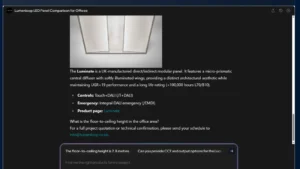
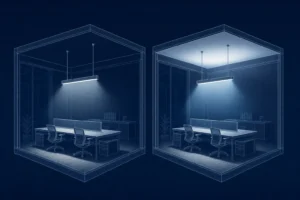
For workplace projects, commercial office lighting systems should be selected around task-plane requirements, glare control, ceiling type, controls, emergency provision and how the space is actually used. In existing workplaces, an office LED lighting upgrade can also help connect energy saving, product replacement and refurbishment constraints in one brief.
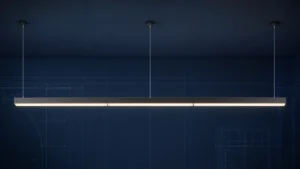
Product type matters too. Commercial downlights can suit reception areas, hospitality spaces, circulation routes and meeting rooms where ceiling detail, beam control and visual comfort matter. Linear lighting systems are better suited to continuous runs, open-plan areas, corridors and shared commercial spaces. For grid ceilings, LED panel lighting can provide a cleaner replacement route for ageing fluorescent panels when glare, output and ceiling compatibility are properly checked.
The right product choice reduces the chance of overspecification, underperformance and premature replacement.
Resolve controls and emergency lighting early
Controls are often added too late in the process, which can create waste through redesign, rewiring or incompatible product choices.
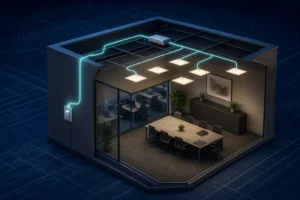
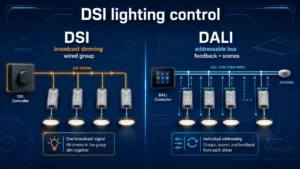
If a scheme needs DALI, Casambi, sensors, daylight dimming or scene control, those requirements should be considered before the luminaire reference is fixed. Choosing compatible lighting controls early helps reduce the risk of changing drivers, replacing fittings or compromising the control strategy later.
The same applies to emergency lighting. Emergency provision should be coordinated with the main lighting schedule so that conversions, standalone emergency fittings and exit signage are planned properly from the start.
Use specification support before the schedule is locked
The easiest way to reduce avoidable waste is to challenge the lighting schedule before procurement.
A better brief should include the application, ceiling condition, target output, glare requirements, control strategy, emergency scope, maintenance access and circularity requirements. That gives the manufacturer or supplier enough context to recommend a tighter product selection before unsuitable fittings are ordered.
For project teams comparing product routes, commercial lighting specification support can help connect the lighting schedule to product families, controls, emergency options and circularity evidence before the scheme is fixed.
Global Generation and Trends
Electronic waste has become the fastest‑growing solid waste stream on the planet.
In 2022, global e‑waste generation reached 62 million tonnes, up 82 per cent since 2010¹. That equates to 7.8 kg per person on average⁴ and would fill over 1.5 million 40‑tonne trucks if lined up end to end⁵. Despite this surge, documented recycling has not kept pace—only 22.3 per cent of 2022’s total was properly collected and processed, down from 30 per cent in 2010¹.
The annual growth rate of e‑waste is approximately 2.6 million tonnes, forecasting 82 million tonnes by 2030 and a staggering 120 million tonnes by 2050². If collection rates remain stagnant—or fall slightly to 20 per cent by 2030—the gap between generation and recycling will widen further⁶.
Toxicity and Environmental Impact
E‑waste is laden with hazardous substances that pose severe risks to human health and ecosystems.
It accounts for roughly 70 per cent of all toxic waste globally⁷. Fluorescent lamps, batteries and circuit boards contain mercury, lead, cadmium and brominated flame retardants, which can leach into soil and water if not properly handled⁷.
Improper disposal of lighting equipment alone is estimated to release around 50 tonnes of mercury into the environment each year¹⁴. This contributes to air and water pollution, bioaccumulation in food chains and neurological damage in vulnerable populations.
On the other hand, formally recycling e‑waste prevents millions of tonnes of CO₂‑equivalent emissions. In 2022, responsible processing avoided an estimated 93 million tonnes of CO₂‑eq through material recovery and reduced need for virgin extraction⁸.
Recoverable Resource Value
Electronic devices contain a wealth of precious and base metals ready for reuse. Globally, US $62 billion worth of raw materials was discarded as e‑waste in 2022, yet under 23 per cent was reclaimed¹.
Key recovery figures include:
1 million laptops recycled saves enough energy to power 3 600 homes for one year⁹.
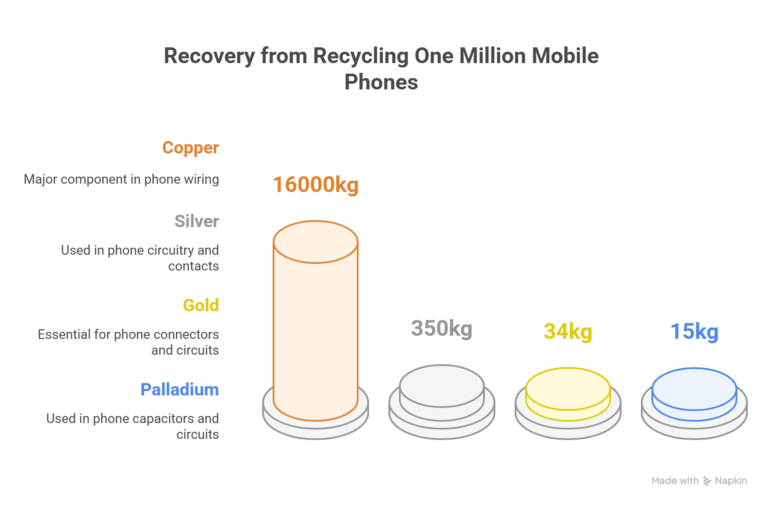
1 million mobile phones can yield 34 kg of gold, 350 kg of silver and 15 kg of palladium¹⁰.
1 tonne of circuit boards contains 40–800 times more gold and 30–40 times more copper than the same weight of mined ore¹¹.
These figures highlight the enormous potential of urban mining—recovering strategic metals from our own waste streams rather than depleting natural reserves.
Regional Focus: United Kingdom
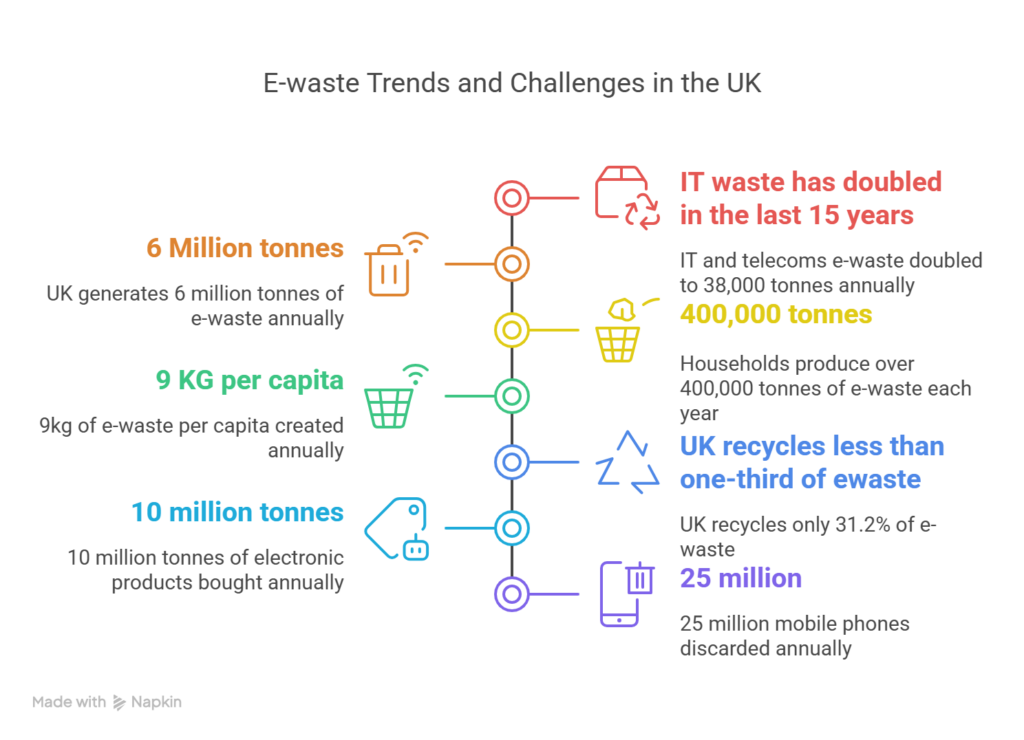
The UK ranks among the highest per‑capita producers of e‑waste. In 2022, Britons generated 23.9 kg per person, second only to Norway among all nations¹². Household collections averaged 120 000 tonnes per quarter—around 480 000 tonnes annually—through municipal drop‑off points and private take‑back schemes¹³.
Formal e‑waste collection in 2022 totalled 505 445 tonnes, representing just 31.2 per cent of the UK’s waste electrical and electronic equipment (WEEE)¹⁴. Despite robust legislation (the WEEE Regulations 2013) and thousands of local collection sites, two‑thirds of UK e‑waste still evades proper processing.
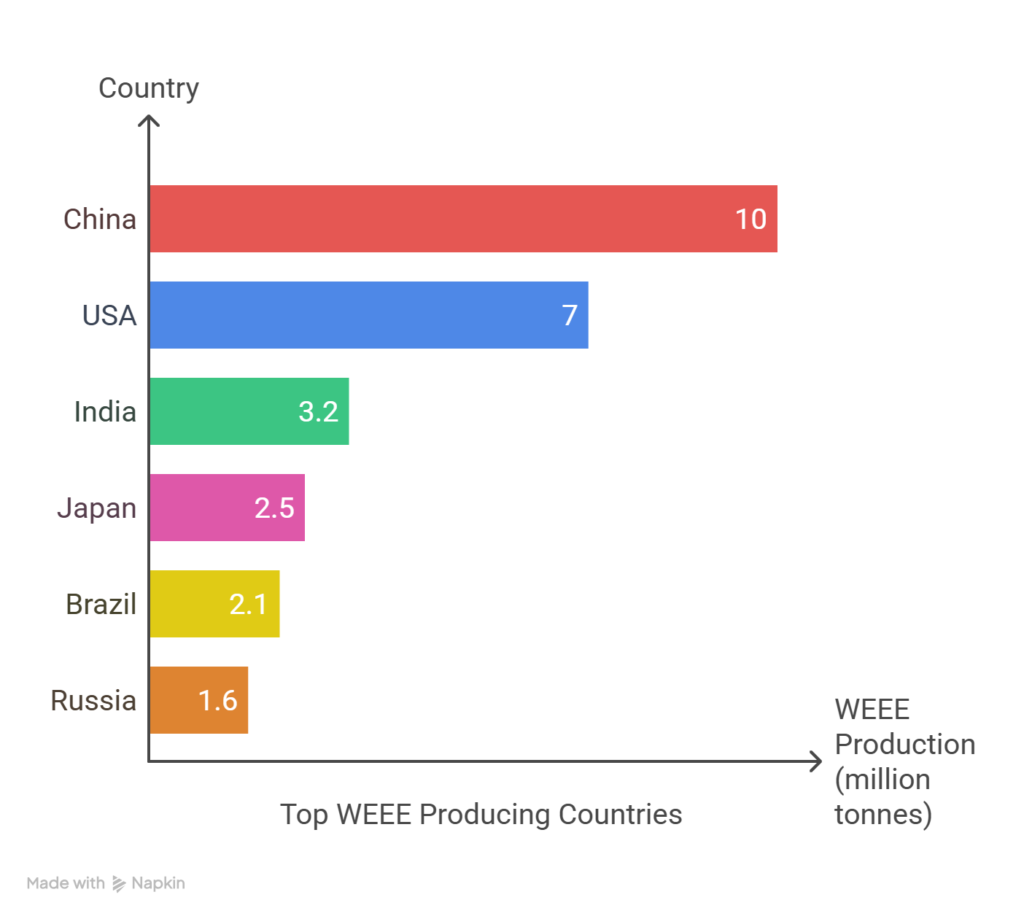
Top E‑Waste Producing Countries
| Rank | Country | E‑Waste Generated (kt, 2021) | Documented Recycling Rate |
|---|---|---|---|
| 1 | China | 10 129 | 16 per cent⁶ |
| 2 | USA | 6 918 | 15 per cent⁶ |
| 3 | India | 3 230 | 1 per cent⁶ |
| 4 | Japan | 2 569 | 22 per cent⁶ |
| 5 | Brazil | 2 143 | — |
| 6 | Russia | 1 631 | 6 per cent⁶ |
Together, these six account for over 55 per cent of global e‑waste generation⁶.
Lighting Equipment Waste
Discarded lamps and luminaires form a significant sub‑stream of WEEE. Though precise breakdowns vary, fluorescent tubes and compact fluorescents contributed roughly 1 million tonnes of lamp waste in 2019, growing at over 4 per cent annually⁶. Each CFL can contain 3–5 mg of mercury, and without proper recycling, the lighting segment alone contributes significantly to that 50 tonnes of mercury lost each year¹⁴.
Recycling programmes for lamps focus on mercury vapour capture, glass and phosphor separation, and recovery of rare earth elements—critical inputs for new LED phosphors.
Regional Recycling Rates and Challenges
Recycling performance varies widely by region. In 2019, Europe led with a 42.5 per cent e‑waste recycling rate, followed by Asia at 11.7 per cent, the Americas at 9.4 per cent, Oceania at 8.8 per cent, and Africa lagging at 0.9 per cent⁶. This uneven picture reflects disparities in infrastructure, legislation, consumer awareness and the capacity to enforce regulations.
Future Projections and Policy Imperatives
If current trajectories persist, annual e‑waste will swell to 82 million tonnes by 2030, with only 20 per cent properly recycled, unless significant investments in collection and processing are made².
By 2050, total e‑waste could reach 120 million tonnes².
Closing the loop will require:
Stronger enforcement of producer responsibility and landfill bans
Expanded take‑back networks, especially in developing regions
Design for disassembly to simplify material recovery
Consumer education on safe drop‑off and donation options
Failing to ramp up these efforts will exacerbate toxic pollution, forfeit billions in resource value, and deepen the global climate footprint of electronic consumption.
References
ITU & United Nations University, Global E‑Waste Monitor 2024, 2024 E-Waste Monitor
Platform for Accelerating the Circular Economy & UN E‑Waste Coalition, “Global e‑waste on track to reach 120 Mt by 2050,” press release, 24 January 2019 UNEP – UN Environment Programme
Central Virginia Waste Management Authority, “Recycling and Energy,” CVWMA cvwma.com
Green Group, “34 kg of gold, 350 kg of silver and 15 kg of palladium recovered from one million recycled mobile phones,” 22 February 2024 Sustainability Today
U.S. EPA, “Frequent Questions about the Sustainable Materials Management Electronics Challenge,” last updated 5 months ago US EPA
Vanessa Forti, “Global electronic waste up 21% in five years, and recycling isn’t keeping pace,” World Economic Forum, July 2020 World Economic Forum
The Roundup, “17 Shocking E‑Waste Statistics In 2025,” last year TheRoundup
United Nations University, “Global E‑Waste Monitor 2024: recycling rate forecast to drop to 20% by 2030,” media release UNITAR
CVWMA (ibid.), “Recycling 1 million laptops would save the energy needed to power 3,600 U.S. homes for a year” cvwma.com
Green Group (ibid.), “Recovered from one million recycled mobile phones” Sustainability Today
U.S. EPA (ibid.), “One metric ton of circuit boards can contain 40 to 800 times the amount of gold…” US EPA
Green Economy, “UK to be top e‑waste contributor by 2024,” 13 September 2023 Green Economy
Statista, “On average, 120,000 t of household e‑waste are collected each quarter in the UK,” 2024 Statista
Statista, “In 2022, the United Kingdom formally collected less than one‑third of the e‑waste it generated, amounting to 505 445 t,” 2024 Statista
WEEE statistics.pdf, “50 tonnes of mercury lost every year through improper e‑waste disposal”